Kia has revealed plans for a new petrol turbocharged engine at its business briefing earlier this week. The Korean carmaker calls it a “modular, high-efficiency engine”, which will be used not just to power pure internal combustion engine (ICE) models, but also as in its hybrid and range-extender electric vehicles (REEV) too.
Not much has been shared on the engine thus far, except that it will displace 2.5 litres, and paired to a turbocharger. Compared to its predecessors, Kia says the new 2.5T-GDi engine boasts a 5% improvement in thermal efficiency, alongside a 12% jump in power.

Based on the current Smartstream 2.5-litre turbo-four mill, the upcoming engine could offer upwards of 350 hp in pure ICE form, with that number boosted even higher when paired to an electric motor.
With the new engine, Kia says its hybrid powertrains will be 4% more fuel efficient than before. The more powerful engine will also offer a smoother transition between engine and motor propulsion, in addition to improved acceleration.
ALSO READ: Kia to introduce more affordable models in Asia Pacific starting 2025, including EVs and hybrids

The new engine will play a large role in Kia’s plans to achieve its targets of 4.29 million unit sales in 2030 – of which, 1.07 million will be xHEV (hybrid, plug-in hybrid, and REEV) models. To do that, the Korean carmaker will be unveiling 10 new xHEV models across all segments, from compact to full-size vehicles, specifically calling out “vehicles such as the Seltos and Telluride SUVs”.
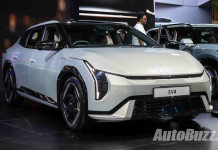
Meanwhile, targets for EVs have been cut by roughly 20%, down from 1.6 million to 1.26 million EVs by 2030. Kia cites uncertainty in US automotive policy as a reason for its revised targets. Despite that, the marque will still be unveiling a full range of 15 EV models by 2030, including the EV3, EV4, EV5, and EV2.
The EV models will also include three electric vans from its PBV light commercial vehicles line-up, as well as an EV pickup truck. Kia says it will retain manufacturing flexibility by continuing to build ICE, hybrid, and EV models across all 13 of its existing plants, while increasing efficiency with two new dedicated EV factories.
also read: Kia EV9 – The SUV with MPV practicality, and much more