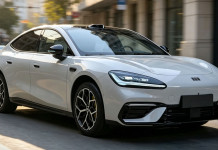
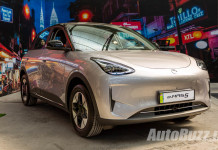
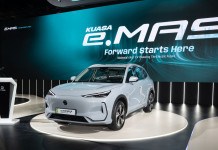
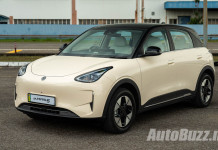
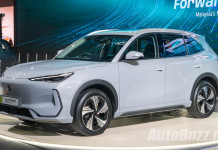
Alongside the launch of the Geely EX5 in Australia yesterday, Geely has also announced that there will be six more hybrid or electric vehicles (EV) within the next three years. Among these cars will be the Geely Galaxy Starship 7, the PHEV counterpart to the EX5 and Proton eMAS 7.
Speaking to Drive, Geely Australia boss Lei Li said that the Chinese carmaker’s next model will hit Geely showrooms by the end of the year. While the model was not directly confirmed, a slide shown during the launch of the Australian EX5 featured an SUV model’s front fascia, which closely resembles that of the Geely Galaxy Starship 7.

The mid-size D-segment crossover SUV will be butting heads against other plug-in hybrid (PHEV) rivals in Australia, such as the BYD Sealion 6, Toyota RAV 4 Hybrid, Nissan X-Trail E-Power, and Honda CR-V e:HEV RS.
According to the Australian publication, the upcoming PHEV will probably drop the ‘Galaxy’ suffix from its name, or even change the badging to an entirely different one.

Pricing is also not confirmed as of yet by the Chinese marque, but if we infer based on the Geely Galaxy EX5 and Geely Galaxy Starship 7’s pricing in China – which are on sale from CNY107,800 (approx. RM66k) and RMB97,800 (approx. RM60k) respectively – the PHEV could be cheaper than its full EV sibling in Australia as well.
If that is the case, the Geely Galaxy Starship 7 will see an estimated price tag below the AUD40,000 (approx. RM112k) mark, which undercuts the AUD42,990 (approx. RM120k) BYD Sealion 6 and AUD42,260 (approx. RM118k) Toyota RAV 4 Hybrid.

Built on the Global Intelligent New Energy Architecture (GEA), same as the Geely EX5, the lengthened Galaxy series car has a 1.5-litre inline-four petrol engine underneath the bonnet pushing out 215 hp (160 kW) and 262 Nm of torque.
On top of that, the Geely Galaxy Starship 7 is also supplemented by a lithium-iron phosphate (LFP) battery pack, which is available in two different configurations. The first being a smaller 8.5 kWh battery pack translating to 55 km of CLTC-rated EV range, and the second a larger 19.09 kWh battery pack with up to 120 km of CLTC-rated EV range.
Depending on the variant, the Geely Galaxy Starship 7 has a total driving range of up to 1,420 km in hybrid mode.

Closer to home, the Geely Galaxy line-up is currently available here in Malaysia solely under the guise of the fully electric Proton eMAS 7. The rebadged Geely Galaxy EX5 is available in two variants, Prime and Premium, and is equipped with a front-mounted electric motor putting down 218 hp (160 kW) and 320 Nm of torque to the front wheels.
Both Proton eMAS 7 variants share a top speed of 175 km/h, but both the Prime and Premium variant have a different 0-100 km/h time of 6.9 seconds and 7.1 seconds respectively. That can be down to the different battery sizes, hence different weight – the Prime variant carries a 49.52 kWh LFP battery pack that’s good for 345 km (WLTP) of EV range, and the Premium variant gets a larger 60.22 kWh LFP battery pack that boasts a 410 km (WLTP) EV range.
Both Prime and Premium variants have 11 kW on-board AC charging, the former having 80 kW DC fast charging and the latter getting a faster 100 kW DC fast charging.

Proton had also revealed that they will be launching at least three new models this year. Specifically, cars built on the Proton Global Modular Architecture (GMA) platform, which the Proton eMAS 7 was built on, renamed from Geely’s GEA. While we don’t know what the next eMAS prospect will be, it would most likely be a smaller EV based on the Geely Xingyuan – or could the PHEV, based on the Geely Galaxy Starship 7, make an appearance too?
READ: Proton to launch at least 3 new models in 2025 – what could they be?
GALLERY