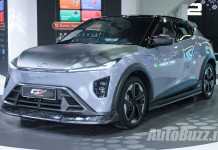
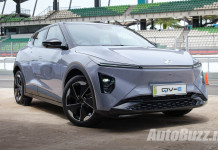
Together with the launch of the 2025 Perodua QV-E, the full ASEAN NCAP (New Car Assessment Program for Southeast Asian Countries) safety assessment report has now been released. Tested under the soon-to-be-outgoing 2021-2025 protocol, the country’s first-ever “fully homegrown” electric vehicle (EV) has been awarded a safety rating of five stars.
The Produa QV-E achieved an overall score of 88.36 points in the tests. The score is broken down to 29.31 out of 32.00 points in the adult occupant protection (AOP) test, 42.67 out of 51.00 points in the child occupant protection (COP) test, 21.00 out of 21.00 points in the safety assist test, and 12.00 out of 16.00 points in the motorcyclist safety (MS) test.

On the adult occupant protection (AOP) test, the report states that the frontal occupant compartment of the Perodua QV-E remained stable during the frontal offset test. However, the passenger-side dummy recorded marginal protection for the chest area while the driver-side dummy received adequate protection. The side impact tests show perfectly good protection levels, with the report acknowledging the performance of the head protection technology.
The Perodua QV-E comes equipped with six airbags, a surround view camera, front and rear corner sensors, and a built-in driving video recorder as standard. Notably, it is also the first Perodua model to feature Child Presence Detection (CPD).
ALSO READ: Perodua QV-E’s all-new modular platform could spawn hybrid and REEV models in the future

Building on this focus on child safety, the report showed that the Perodua QV-E managed to score full points in the dynamic test for both 18-month-old and three-year-old children. However, it lost points in the Child Restraint System (CRS) installation assessment, passing only 19 out of 28 on the second-row seats.
Now powered by a radar unit at the front, the Perodua QV-E is also kitted with the Perodua Smart Drive Assist suite of advanced driver assistance systems (ADAS), which includes features such as Adaptive Cruise Control (ACC), Autonomous Emergency Braking (AEB), Forward Collision Warning (FCW), and more.

With most of the required driver-assistance features present and functioning as intended, the Perodua QV-E achieved a full score of 21 points in the Safety Assist category. The report also notes that its AEB systems for both City and Inter-Urban applications meet ASEAN NCAP performance standards.
With the large number of motorcycles in the ASEAN region, motorcycle-related safety systems are strongly encouraged under ASEAN NCAP’s 2021-2025 protocols. The Perodua QV-E met these standards, scoring 12 out of 16 points thanks to the inclusion of a well-functioning Blind Spot Detection (BSD) system.
ALSO READ: Tan Chong Motor to rent out assembly lines for Perodua EV production

The Perodua QV-E is priced at RM80,000 on the road, excluding insurance, and introduces a new ownership model where the battery is leased from Perodua for a monthly fee of around RM275. As the battery remains under Perodua’s ownership, its insurance is fully covered by the company, while the owner is responsible for insuring the rest of the vehicle.
This arrangement enables a lifetime battery warranty, with Perodua offering a replacement if the pack’s state-of-health (SoH) drops below 70%. The rest of the vehicle is covered by a three-year/100,000 km general warranty and a six-year/150,000 km body warranty.
READ MORE: Perodua QV-E launched in Malaysia as nation’s first homegrown EV – RM80k with battery leasing