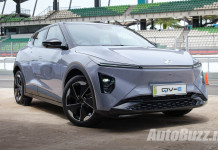
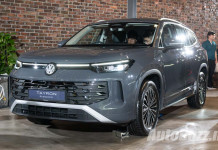
Perodua has just launched its first all-new electric vehicle, the Perodua QV-E. Aside from the new battery leasing model, the next big headline for the QV-E is most definitely Perodua’s “homegrown EV” claim, particularly due to its all-new modular platform that was developed in collaboration with technical partner Magna Steyr.
According to Perodua, this new architecture is highly flexible. It is designed to support not only battery-electric vehicles (BEVs) but also hybrid and range-extended electric vehicles (REEVs) in the future – all with minimal modifications to the core structure.

The all-new platform can accommodate wheelbases ranging from 2,550 mm to 2,700 mm, allowing it to underpin future models spanning the A- and B-segments, including SUVs, sedans, and hatchbacks, Perodua says.
This versatile wheelbase length accommodations also allow Perodua to design vehicles ranging from 3,910 mm to 4,685 mm in length. This technically allows the platform to cover not just A- and B-segments, but extend into the C-segment as well.
Perodua highlights that it retains full ownership of the platform’s intellectual property (IP) rights, and that’s further highlighted by the QV-E’s model code, P01A, instead of the usual ‘D’ prefix on Daihatsu-based models.

With the QV-E launching as the maiden model on this new platform, it remains to be seen what Perodua has planned next. However, with Proton preparing to launch the plug-in hybrid (PHEV) variant of the eMAS 7 (stylised as e.MAS 7) soon, the second national brand could also follow suit by introducing a REEV model down the road.
For now, the Perodua QV-E will be exclusively available as a pure EV model. It features a front-mounted electric motor that produces 204 hp (150 kW) and 285 Nm, enabling a 0-100 km/h sprint in 7.5 seconds and a top speed of 165 km/h.
RELATED: Perodua QV-E launched in Malaysia as nation’s first homegrown EV – RM80k with battery leasing

Juicing the electric motor is a CATL-sourced 52.5 kWh lithium-iron phosphate (LFP) battery that enables a range up to 445 km (NEDC). Charging is supported with 6.6 kW AC charging for a full charge in about eight hours, and 60 kW DC fast charging, which enables a 30-80% recharge in 30 minutes.
Alongside the launch of the Perodua QV-E, the carmaker is also offering the nation’s first “Battery as a Service” (BaaS) model. Under BaaS, Perodua will retain ownership of the high-voltage battery pack, with customers only purchasing the car itself.

This essentially means Perodua will be responsible for insuring the battery, while the owner is responsible for insuring the vehicle. The battery pack also comes with a lifetime warranty, allowing customers to return the battery pack to Perodua for a replacement if its state-of-health (SoH) drops below 70%, with the company responsible for the disposal of the old battery pack.
Under this arrangement, owners of the Perodua QV-E will sign a nine-year lease agreement. The leasing fees will be consolidated into a single monthly repayment to the bank, eliminating the need for separate transactions for the hire-purchase loan and the BaaS subscription.
ALSO READ: Proton eMAS 7 PHEV spotted in camouflage again – national marque’s first hybrid coming soon?