With both Mercedes-AMG and BMW M having introduced their respective plug-in hybrid performance super sedans and wagons, it seems that it is now high time for Audi to join the gang too with the all-new Audi RS5. While these electrified super sedans have faced criticism for their complexity and significant weight gains, Audi believes it has found a way to make the formula work.
At the heart of the all-new Audi RS5 lies a new modular electrified quattro powertrain. It retains the familiar 2.9-litre twin-turbocharged V6 petrol engine from its predecessor, albeit now running a modified version of the Miller combustion cycle to meet upcoming Euro 7 emissions regulations while improving efficiency.

On its own, the V6 produces 510 hp and 600 Nm — a 60 hp (44 kW) increase over before. Paired to the combustion engine is a 177 hp/460 Nm electric motor, integrated into a eight-speed gearbox. Juiced by a 25.9 kWh battery pack (22 kWh net) running on a 400 kW electronic system, the entire hybrid powertrain’s total system output is brought up to a whopping 639 hp and 825 Nm.
Of course, power is sent to all four wheels (AWD), allowing for a century sprint in just 3.6 seconds, while top speed is rated at 285 km/h with the Audi Sport package equipped. There’s even a dedicated boost button that unleashes maximum hybrid power for 10 seconds — much like the boost function seen in the company’s F1 endeavours for the 2026 season.
ALSO READ: Audi’s second “TT moment” is here, and it’s an EV coupe called the Concept C


The battery supports 11 kW AC charging, allowing a full charge in approximately 2.5 hours. Audi claims an all-electric range of up to 84 km (EAER), stretching to 87 km in urban conditions — probably more useful for those who travel through Ultra Low Emission Zones (ULEZ) in the UK and Europe.
But here’s where things get interesting. The Audi RS5 tips the scales at 2,355 kg for the sedan and 2,370 kg for the Avant (the wagon variant). Despite supposedly being positioned below the Audi RS6 Avant, it is actually 280 kg heavier than the larger non-electrified V8-powered model. That’s cruise-ship figures in sports sedan territory — and traditionally, Audi’s performance models haven’t exactly been shy of understeer. So how does Audi plan to mask all that mass?
ALSO READ: Europe is considering pulling the brakes on its 2035 ICE ban

To counter the added weight, Audi has introduced Dynamic Torque Control — featuring a completely new rear transaxle with electro-mechanical torque vectoring – essentially a fancier limited-slip differential. Claimed to be a world first in a production model, the system can channel up to 11 hp (8 kW) to a permanent-magnet synchronous motor housed within the torque vectoring unit.
An eight-speed tiptronic transmission works alongside a limited-slip centre differential, distributing torque variably between 70:30 and 15:85 front-to-rear depending on driving conditions.
Speaking of which, the all-new Audi RS5 also debuts a new RS torque rear driving mode. In this setting, a high proportion of torque is sent to the outside rear wheel, giving the RS5 a far more agile and playful character while maintaining control. Similar in spirit to BMW’s drift mode in its M cars, Audi’s driving experience function also allows drivers to record and analyse data such as lap times, distance covered, and even drift angle.
ALSO READ: Audi’s ugly duckling A2 is reportedly coming back as an EV, to be based on the Volkswagen ID.3

To deliver consistent performance, Audi says the car will ensure that the battery maintains at least a 90% state of charge when RS Sport or RS Torque Rear modes are activated. This guarantees full electric support for torque vectoring and dynamic acceleration.
The battery is actively cooled/heated to an optimal 20 degrees Celsius during high-performance driving. Pumps, fans and heat exchangers work in tandem to maintain consistent output, even under repeated maximum load, ensuring the car delivers its full electrified punch lap after lap.
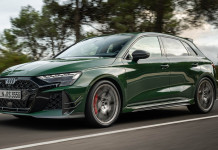
Visually, the all-new Audi RS 5 certainly looks the part of a proper RS model. It sits lower and wider, with each axle extended by four centimetres — making it up to eight centimetres broader than the standard Audi A5. Up front, a three-dimensional honeycomb grille dominates, flanked by darker Matrix LED headlights and blacked-out Four Rings. The RS-specific digital daytime running light signature adopts a chequered-flag design, reinforcing its performance credentials.

Standard fitment includes 20-inch five Y-spoke wheels, with optional forged 21-inch RS wheels in a six twin-spoke design, available in metallic black, neodymium grey matte, or bi-colour diamond-cut and black metallic finishes. Braking is handled by 20-inch RS steel brakes as standard, with optional 21-inch RS ceramic brakes that shave 30 kg compared to the steel setup.
At the rear, a sculpted diffuser with vertical fins adds functional drama, while oval RS exhaust tips sit prominently at the centre. The car sports a stealthier look with gloss black exterior trims. If that’s not enough, there is also an exterior carbon package for a more track-focused aesthetic.
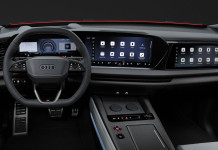
Inside, it largely mirrors the standard A5 model’s layout, albeit with RS-specific enhancements. The driver faces an 11.9-inch digital instrument cluster paired with a 14.5-inch central infotainment display supporting Apple CarPlay and Android Auto. A 10.9-inch passenger display comes as standard, extending the digital experience across the cabin.
ALSO READ: Audi hints at G-Wagon rival as CEO says “stay tuned”


Sport Seats Plus with honeycomb quilting are upholstered in faux leather as standard, complete with heating and massage functions for front occupants. While buyers can configure various colour combinations, the headliner remains black across all variants.
For those wanting something more premium, genuine leather in red or grey is available. Finishing touches include a flat-bottom RS steering wheel wrapped in perforated Nappa leather, complete with a colour-coordinated 12 o’clock marker. Together with model-specific RS badging throughout the cabin, drivers are constantly reminded that they’re behind the wheel of the crème de la crème of Audi’s A5 lineup.
Audi can promise all the technology it wants to mask the weight, but we won’t know how well it works until we get behind the wheel. The BMW M5 has already faced criticism for feeling more like a boat than a super sedan, and on paper, the all-new Audi RS5 seems to be heading down a similar path. Let’s just hope Audi has taken notes from BMW’s experience, and this out to be the absolute unit it was always meant to be. At the very least, enthusiasts can be thankful that Audi resisted downsizing the engine — unlike the Mercedes-AMG C63 S E Performance.
RELATED: All-new Audi A5 unveiled as a replacement the petrol-powered A4
GALLERY