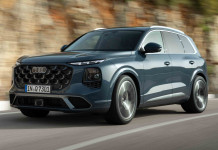
Audi has revealed the interior of its all-new Q9, which will replace the Audi Q7 as the brand’s largest SUV. According to Ingolstadt, its famous ‘Vorsprung durch Technik’, or ‘Progress through technology’ for non-German speakers, will now be defined by the in-car experience. Audi is following the global trend of carmakers with interiors that are arguably more high-tech than the average home.
Obviously, this cannot be achieved without an abundance of screens. The all-new Audi Q9 features three, covering the driver, the centre infotainment, and the front passenger. Audi has not yet revealed the exact specifications for these displays. However, with the current trend of integrating artificial intelligence (AI) into infotainment systems, the Q9 software is likely to follow suit.

What Audi is most proud of is the seating configuration. As standard, it is a seven-seater in a 2+3+2 configuration. The carmaker notes that all three seats in the second row can accommodate child seats. They claim this is a convenient feature for parents, though it sounds like a recipe for a very loud journey involving three rays of sunshine.
Regardless, all seats in the Q9 feature partial power adjustment, and the third-row seatbacks can be folded down individually using electric controls. This is convenient for those needing to switch between transporting passengers and carrying groceries from the supermarket.
For the more business-minded customer, the Audi Q9 can be configured with a six-seat layout. This version features individual captain chairs in the second row for a 2+2+2 configuration. These seats come with active ventilation and, in Audi’s words, are designed to match the level of comfort found in business class.


Continuing the creature comforts, the Audi Q9 will be the first four-ring model to feature electrically powered doors. These can be operated using the myAudi app, the MMI display, the press of the brake pedal, or even the seatbelt buckle. Audi claims that the doors on the Q9 have a wide opening angle to enable easy entry and exit, whether you are carrying heavy shopping or a stroller.
For those worrying if these automatic doors will hit an object or a passerby, Audi has fitted an extensive set of surround sensors with obstacle detection. This system halts the door if there is not enough room to open, which is especially useful in tight parking spaces.
The sensors can also detect approaching cyclists or other road users to improve safety. In any case, we reckon it is still best to use your own eyes to double-check the surroundings rather than fully relying on the car to look out for you.

Other features of the Audi Q9 interior include a panoramic sunroof measuring approximately 1.5 square metres. It can be opened wide for an open-air experience and features nine individually controllable segments that can be switched to opaque to keep the sun out.
As standard, the glass is coated to reflect infrared light and blocks more than 99.5% of UV radiation. Audi says that when the Q9 is parked, the roof automatically turns opaque to prevent prying eyes from seeing what is happening inside. On higher variants, the roof features illumination using 84 LEDs to bathe the glass in one of 30 colours, matching the selected ambient lighting.
Regarding the ambient lighting, the Audi Q9 features contour lighting on the dashboard and door cards to accentuate the width of the cabin. As standard, it comes with full illumination for the front doors, though this remains an optional extra for those sitting in the back. There is also a dynamic interaction light (IAL), which is a continuous LED strip spanning the full width of the interior to help the car “talk” to its occupants.
ALSO READ: The Audi A2 and its quirky design is officially coming back this year

When paired with the updated Bang & Olufsen 4D sound system, the interaction light syncs with the rhythm of your music. It creates a colour scheme based on the track’s cover art, perhaps to recreate a miniaturised disco dance floor. This is topped off by speakers in the headrests and actuators in the seats that allow you to physically feel the bass.
To ensure the cabin feels more like a lounge and less like a computer lab, Audi has expanded its range of materials. You can now choose from upholstery options including alpaca wool, Dinamica microfibre, and fine Nappa leather.
These are paired with decorative trims such as natural grain ash, lime structure, or carbon fibre weave with basalt grey accents. Audi has also notably reduced the use of glossy surfaces in favour of matte and textured materials, which is a blessing for anyone who hates seeing fingerprint smudges on the interior surfaces.

On the practical side, the redesigned centre console features two wireless charging pads compliant with the Qi2.2 standard and USB-C ports that deliver up to 100 watts. This dual charger allows for the fast charging of two smartphones simultaneously.
In the back, a new aluminium rail system in the trunk allows you to secure cargo using sliding hooks and adjustable anchors, keeping the floor space clear for larger items. Audi even includes a roof rack for the standard roof rails with every purchase of the Q9, for owners to really use their Q9 for road trips.
That is all Audi is keen to reveal about its flagship Q9 for now, with the rest of the details set to be unveiled in around two months at its world premiere in Summer 2026.
READ MORE: The Audi RS3 Competition Limited is the Four Ring’s 50th-anniversary gift to the 5-cylinder engine
GALLERY