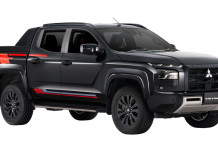
Mitsubishi confirmed earlier this decade that a fully electric version of its Triton pickup truck would be coming as soon as 2028, but work on the EV pickup has apparently been stalled to make way for a hybrid model.
Speaking to Australian media at the Tokyo motor show, Mitsubishi engineering fellow Kaoru Sawase said through a translator, “In the past, we have announced [plans] to launch BEV, [a] battery-electric vehicle Triton. But now that the direction has shifted a little bit, we are now trying to quickly launch electrified [hybrid] vehicles.”
“First, we have to work on hybrid (HEV), not the way of plug-in hybrid (PHEV),” Sawase-san added.

The development of the hybrid Mitsubishi Triton was spurred by the need for a model that’ll meet stringent emissions rules globally “that is actually going to be wanted by customers”, Sawase-san explained.
Demand for fully electric pickup trucks have significantly waned in recent years, while HEV and PHEV models – including the BYD Shark 6 that was recently previewed in Malaysia – has seen a surge in popularity, particularly in Australia.

While a PHEV is still on the table, Sawase-san says a “regular” hybrid, along with a more traditional P2 hybrid layout and mechanical four-wheel drive (4WD) is the best way forward for the medium term, particularly in the context of battery and electric motor cooling during extreme off-roading.
“[My] personal opinion, it is very difficult for Triton or Pajero [to go electric] … because of the motor and heating program. Also [the] battery,” he said.
READ MORE: 2025 Mitsubishi Triton Athlete updated with improved kit – now RM6k cheaper, from RM160k

Sawase-san revealed that while testing the BYD Shark 6 at the marque’s proving ground in Japan, the mostly electric-driven PHEV pickup showed tendencies to overheat and activate “system protection” in off-road driving.
“They can climb uphill, but it doesn’t last very long. For a while they climb it up, but they then stop; the system protection kicks in. My feeling is that the electrified off-road vehicle development is a challenge.”

The P2 hybrid layout, with the electric motor sandwiched between the engine and gearbox, will allow for the pickup truck to still retain its mechanical 4WD system, including the low-range transfer case and locking differentials – similar to the system used on GWM’s Hi4T hybrid 4WD technology, but here without charging capabilities.
“We have been working on advanced developments from a few years ago”, Sawase-san added, “[but] personally, for the next five years, I believe that for pure off-road, we should go for the way of mechanical 4WD … After five years, there’s also a good potential that the EV can also do the pure off-road 4WD, [in] an off-road vehicle. We are watching other technologies’ development.”
ALSO READ: GWM Hi4 tech explained – Off-road-ready hybrid 4WD systems that’ll even save you fuel!

The upcoming hybrid Mitsubishi Triton’s electrification technology will be developed completely in house, rather than in partnership with Nissan – whose upcoming Navara will be based on the Triton – to fast-track development.
“We are thinking about launching, developing this vehicle standalone for this [frame] vehicle, we call it. And so, first, we want to develop this as a Mitsubishi Motors technology and there’s no impact of Nissan Navara for speeding up the development,” Sawase-san said.
[Source: Drive.com.au]