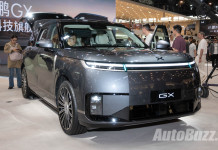
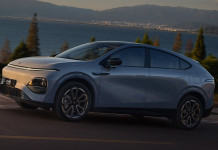
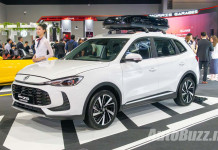
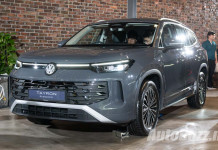
XPeng has just unveiled the fully electric (EV) XPeng G7 in China. Positioned above the XPeng G6, the G7 will be available in two variants in China, called the Max and Ultra, and is now available for pre-sale in China starting from RMB235,800 (approx. RM139k).
Not only are their variant names evocative of the mobile phones you’re probably reading this from, like all new tech product in 2025, the XPeng G7 will also make heavy use of “AI”, specifically for its advanced driver assistance system (ADAS) that are powered by the company’s in-house developed Turing AI chips.

On the Ultra variant, the G7 boasts a total computing power of 2200 Trillions of Operations Per Second (TOPS) from its three Turing AI chips. With this, XPeng claims the G7 is the first car to achieve SAE Level 3 conditional autonomous driving computing capability.
These are paired together with an augmented reality heads-up display (AR-HUD) that is developed in collaboration with Huawei that “paints” the route onto the HUD, with instructions relayed through a projected “light carpet” for the driver to follow specified lane changes, roundabouts exits, and entering and exiting highway ramps.
RELATED: 2nd-gen Xpeng P7 gets scissor doors, looks more Cyberpunk than the Tesla Cybertruck

Additionally, the AR-HUD on the XPeng G7 is also able to project warnings for risks like cars cutting in, pedestrians, and during adverse weather conditions. It can even project the XPeng G7’s camera feed onto the AR-HUD for manoeuvring in tight spaces, as demonstrated on XPeng’s website.
If you think the XPeng G7’s ADAS system is pretty smart, XPeng says it is. They claim it can constantly evolve and learn on its own, thanks to what they call the “Visualised Large Model – Online Learning” (VLA-OL).
Through VLA-OL, XPeng says the camera system on the G7 constantly observes the world with far greater accuracy. This lays the foundation for future, more advanced and capable SAE-Level 4 or Level 5 fully autonomous driving.


All of these ADAS systems are packaged within an exterior design that shows off XPeng’s second-generation “X-face” design language. This design features a much bolder and more aggressive front, with daytime running lights (DRLs) separated into three elements across the front bumper, and the main headlight units positioned within the bumper itself.
Towards the rear of the XPeng G7, its sculpted design might resemble that of the Kia EV6. However, a unique feature of the G7 is its taillights, which are separated into two tiers, with the upper part getting full-width taillights.

Inside, the XPeng G7 boasts an interior featuring 39 storage compartments. The rear headroom, XPeng claims, is comfortable even for a 1.9-metre tall individual. Other practical features of the XPeng G7 include a boot space of 819 litres, which can be expanded to 2,277 litres with the rear seats folded down.
For tech features, the XPeng G7 features a 15.6-inch central touchscreen infotainment display on the dashboard, an eight-inch rear infotainment display for the rear passengers on the centre console, a nine-inch digital rearview mirror, and three wireless 50W chargers.
Other interior features of the XPeng G7 include folding tray tables and “Cloud-Sense” Nappa leather upholstered seats with ventilation, heating, and massaging functions for the driver and front passenger.

Powering the XPeng G7 is a rear-mounted electric motor that produces 296 hp (218 kW) across both variants. This can be paired with a 68.5 kWh lithium-iron phosphate (LFP) battery pack, offering a CLTC range of 602 km on 18-inch wheels or 577 km on 20-inch wheels.
Alternatively, a larger 80.8 kWh LFP battery pack is available, enabling a CLTC range of 702 km on 18-inch wheels or 677 km on 20-inch wheels, both battery packs sourced from CALB.
So, the XPeng G7 packs a serious punch with its advanced ADAS, unique design, and spacious, smart interior. As it begins its journey in China, the exciting question for us is: will the Xpeng G7 eventually make its way to Malaysian roads?
ALSO READ: XPeng X9 updated for 2025 with bigger batteries and Rolls-Royce-style hubcaps
GALLERY