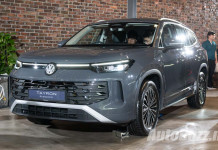
This is Volvo’s most powerful car yet and while its century sprint time is up there with the supercars… this Swedish steel measuring contest is calculated in computing power. The future is now so say welcome to the all-new, all-electric Volvo ES90.

Modern vehicle design has adopted plenty of fluidity, blurring the line between the traditional body styles we’ve become accustomed to and inadvertently greenlighting carmakers to label them ridiculous things. The ES90 falls into that category, too, with its somewhat three-box shape plus a slightly taller ride height, but Volvo has embraced that ambiguity, leaving us to decide exactly where it fits.
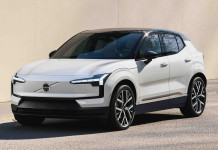
The silhouette might be open to interpretation but everything within it is typical Volvo, such as the ‘Thor’s Hammer’ headlights that sit above vertical driving lamps. At the rear are C-shaped taillights while additional LED lights are embedded in the rear windscreen to form a unique welcome and farewell light sequence.

Underpinning the ES90 is the same SPA2 architecture shared with the EX90 but with altered dimensions. Its overall length of 5,000 mm is shorter than the EX90 but it has a longer wheelbase at 3,102 mm. Nonetheless, the raised ride height of 203 mm is still lover than the EX90.
Regardless of the body style, the sloping roofline of the ES90 makes it their most aerodynamic model to date, with a drag coefficient of 0.25 Cd.
RELATED: 2025 Volvo XC90 facelift and fully electric EX90 now open for ROI – Malaysia launch soon

The ES90 holds the distinction of being the brand’s first model with 800V architecture. Some of the key points with the higher voltage system includes a range of up to 700 km as well as the ability to charge at 350 kW and regain 300 km of range in just 10 minutes. Additionally, going from 10-80% takes only 20 minutes.
Three variants will be made available at launch. The Single Motor version, as the name suggests, will have one 245 hp motor driving the rear wheels and comes with a 92 kWh battery for a 644 km range.

Above that will be the Twin Motor Volvo ES90 with an extra propulsion unit on the front axle. Power climbs to 442 hp and the larger 106 kWh battery pack delivers the aforementioned 700km of range.
The top dog variant is the Twin Motor Performance. It retains the same larger battery but power is boosted to 670 hp. That’s good for a century sprint of 3.9 seconds though the top speed is limited to 180 km/h, like all new Volvos. Curiously, it manages to retain the 700 km range.

Given that Volvo describes the ES90 as its most powerful car in terms of computing power, the core reason is due to it running on a dual Nvidia Drive AGX Orin configuration that can process over 500 trillion operations per second.
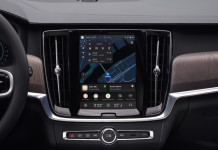
On the infotainment side, the ES90 runs on Volvo’s new system equipped with Google Built-In, including Google Assistant, Google Maps and other apps from the Play Store. It’s 5G-capable and is powered by the Snapdragon Cockpit Platform from Qualcomm Technologies.
RELATED: 2025 Volvo EC40 launched in Malaysia – renamed C40 with longer 554 km range, RM289k

The cabin itself is distinctively Volvo, seamlessly blending minimalist with a rich ambience. A 14.5-inch central portrait touchscreen is the command centre for the infotainment while the driver gets a narrow 9.0-inch display in place of the instrument cluster to monitor all important info.
Completing the cabin’s amenities are some top shelf features as well. First comes a quad-zone climate control system with an Allergy Standards Limited certified advanced air purifier that can stop 95% of PM 2.5 particulates and filter 99.9% of allergens.
RELATED: Electrified models accounted for 83% of Volvo Car Malaysia sales in a record-setting 2024

The flagship 25-speaker Bowers & Wilkins stereo has the benefit of functioning within Volvo’s quietest cabin yet and aided by lifelike spatial audio from Dolby Atmos. Lastly is a panoramic roof with UV protection of up to 99.9% and the optional electrochromic version allows adjustment of the transparency.
As with all of the marque’s latest models, buttons are scarce apart from those on the steering wheel and window switches.

Volvo engineered the ES90 to meet their rigorous Volvo Cars Safety Standard, a benchmark built on 55 years of real-world safety research that exceeds official testing requirements.
Active safety is backed up by an array of sensors comprising five radars, seven cameras, twelve ultrasonic sensors and a lidar.
The safety system is integrated into the connectivity suite, and the ES90 can even communicate with other Volvo cars around, including receiving notifications sent from a Volvo ahead that has detected an incident on the road.
GALLERY