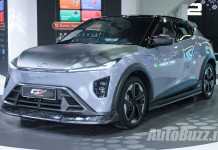
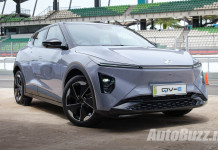
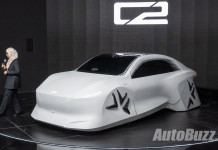
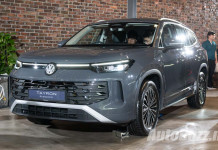
Perodua has unveiled the eMO-II concept at the Kuala Lumpur International Mobility Show 2024 (KLIMS 2024), the latest in its multi-“episode” preview. The eMO-II (pronounced “M-O-2”) is the third prototype in Perodua’s development journey of its first ever electric vehicle (EV) model, which is set to make its official debut sometime in 2025.
The Perodua eMO-II is a significant leap in terms of progress over the eMO-I concept, as it is now a full-sized model with a proper rolling chassis (albeit with a fibreglass body), instead of a static model as before. The concept was driven out onto the show floor during the unveiling ceremony today.

Aside from a functioning powertrain, the eMO-II concept also gives us a glimpse of what the upcoming production EV might look like, showcasing a new design language never before seen on any other Perodua models.
The national carmaker says that the design incorporates “21st century aesthetics with Malaysian uniqueness”, the latter most notable via the LED lighting elements on both the front and rear fascia, which Perodua says integrates the design of the Malaysia songket.

Perodua did not reveal any technical specifications for the eMO-II, but mentions that the eventual production vehicle will occupy the “lower b-segment” of vehicles in terms of size, which makes sense given its targeted sub-RM100k price point.
Perodua President and Chief Executive Officer, Dato’ Sri Zainal Abidin Ahmad also revealed that the model is fully developed in-house by Perodua R&D, engaging key technology partners for specific parts and hardware, such as CATL for the lithium iron phosphate (LFP) EV battery.

Based on prior “targeted” specifications revealed during Malaysia Auto Show 2024, the eventual production Perodua EV will be powered by a single motor on the front axle making 160 hp (120 kW) and 220 Nm of torque. Perodua will also be targetting a range of around 400 km in a single charge, courtesy of a battery sized between 50-60 kWh.
“Please keep in mind that this is still a prototype model and there are plenty of other features and improvements that we will add to our finished product, which we will introduce in the near future,” Dato’ Sri Zainal said.
GALLERY