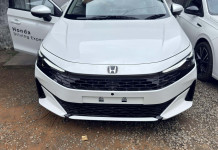
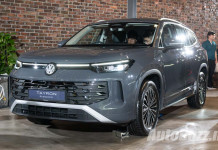
Honda’s global EV plans might have been put on hold, but closer to home, it’s still business as usual with the debut of the Honda e:N2 in Thailand during the ongoing 2026 Bangkok International Motor Show.
Like its e:N1 sibling, the Honda e:N2 also goes by many names internationally, including the iconic “Insight” nameplate in Japan. No matter their name, though, they’re all essentially rebadged versions of the Honda e:NS2, built by Dongfeng Honda in China.

The Honda e:N2 is built on the same “Honda e:N Architecture F” as the e:N1, but being the elder sibling in the family, it’s also the bigger of the duo, measuring in at 4,788 mm long, 1,838 mm wide, and 1,570 mm tall, with a 2,733 mm wheelbase – putting it right in contention with other C-segment EV SUVs such as the BYD Atto 3 and Proton eMAS 7 (stylised as e.MAS 7).
Compared to the e:N1, which basically just looks like a more environmentally friendly Honda HR-V, the e:N2 certainly looks a lot more, let’s call it stylised, with a fastback-like roofline, sharp arrow-like headlights, and a full-width taillight signature unlike any other Honda on sale. They say beauty lies in the eyes of the beholder, but this doesn’t seem exactly pretty in our opinion… at least the slimline horizontal front grille and rear bumper trim looks quite unique.
The door handles are of the hidden pop-out variety (at least for the front doors), and unlike its younger sibling, the Honda e:N2 dispenses with the odd front charging hatch for a more ordinary flap, located above the front-left fender. It’s offered in a single variant in Thailand, equipped with 18-inch dark two-tone wheels as standard.

Similarly, the interior of the e:N2 is also significantly more futuristic than its smaller sibling, thanks to the minimalist dashboard layout, with a 12.9-inch landscape-oriented infotainment touchscreen taking centre stage. This screen now runs on the latest Honda Connect 4.0 operating system, and is paired to a letterbox-style 9.4-inch instrument cluster behind the steering wheel, alongside an “11.5-inch” head-up display.
Other standard features on the Honda e:N2 in Thailand include powered front seats with seat ventilation, dual-zone automatic climate control with rear air vents and an air fragrance system, sunroof, Qi wireless charging pad, a 12-speaker Bose sound system, and wireless Apple CarPlay and Android Auto connectivity.
The seats are wrapped in two-tone grey-and-black upholstery, with orange accents on the dashboard, door cards, and headrests giving the whole interior a more lively ambience.
READ MORE: Honda Prelude to launch in Malaysia in 2026? 6 new models planned for this year

Driving duties are handled by a single motor on the front axle, the same unit as the e:N1, producing 204 hp (150 kW) and 310 Nm of torque. Electric juice is also supplied by the same 68.8 kWh nickel manganese cobalt (NMC) battery sourced from CATL, but perhaps due to its slightly more aerodynamic shape, the Honda e:N2 boasts slightly higher range at 530 km (NEDC), compared to 500 km on the e:N1.
Charging is supported at up to 78 kW using a DC fast charger, taking approximately 40 minutes to go from 30-80%, while the on-board AC charger takes in 6.6 kW of power (single phase), interestingly lower than the 10 kW supported by the e:N1 – at least here in Malaysia.
Pricing for the Honda e:N2 in Thailand starts at THB1.143 million (approx RM171k), making it THB230,000 (approx. RM28k) dearer than the e:N1 in the Kingdom. For reference, the e:N1 is officially priced at RM150,060 here in Malaysia, although frequent discounts regularly bring it down closer to the RM110k mark.

So would the e:N2 eventually make its way into Malaysia too after its regional debut in Thailand? Well, Honda Malaysia did previously announce plans to introduce three EV models by 2027, including the e:N1 which made its official debut here last year.
But for the Honda e:N2, unless the company is planning on locally assembling the model here, we think chances for that happening might be slim, given the new RM250k floor price requirement for fully imported EVs into Malaysia. That said, the exact plans are probably knowledge limited to only those within Honda Malaysia’s boardrooms, and who knows? Stranger things have happened…
GALLERY