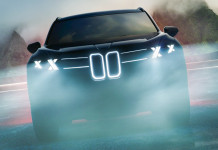
It’s no secret that BMW’s M division is making a fully electric performance car. Ahead of its official debut sometime towards the end of this year, the company has now shown off its fully camouflaged prototype, alongside some key information that’ll hopefully keep its fans excited until its launch.
While full specifications for the EV M car will still remain under wraps for a while longer, Munich has now revealed that the first silent M car will sit on an all-new 800V architecture, and based on BMW’s Gen6 eDrive technology. It won’t be an easy task replacing the petrol engines, But BMW is hoping that a bonkers quad-motor setup, featuring two electric motors on each axle, will at least be a good enough substitute.

According to BMW, these motors are the most powerful ever used by the M division, with each individual wheel receiving its own dedicated gearbox and inverter. Could the electric M3 pack a four-figure output? Given current trends, it is entirely plausible.
To maintain control, BMW employs a centralised processing architecture featuring four high-performance computers, dubbed “Superbrains”. These units combine to form the ‘Heart of Joy’ control system, which manages driving dynamics. By monitoring the motors in real-time, it can precisely fine-tune torque and power at each wheel with millisecond accuracy.
This technology was showcased in the BMW Vision Driving Experience prototype, which produced a whopping 18,000 Nm of torque to the wheels, specifically to test the software’s capabilities under extreme stress.
RELATED: BMW 218 Gran Coupe gets Iconic Glow grille – limited to 150 units, no extra cost

In turn, these motors are fed by a battery pack with over 100 kWh of usable energy, governed by a performance-optimised ‘Energy Master’ control unit. This Gen6 management system prioritises sustained track performance and rapid 800V charging over pure efficiency.
While standard Neue Klasse models are expected to reach a range of up to 900 km, with the BMW iX3 – the first model built on the platform – already rated at 805 km (WLTP), the M-badged sedan will likely trade some of that distance for performance, with a range target of around 600 km instead.
Beyond providing energy, the battery housing also acts as a structural backbone, connecting the axles to significantly increase chassis stiffness and handling precision.
ALSO READ: Next-generation electric BMW M3 will reportedly be called “iM3”, to begin production in 2027

To ensure the car doesn’t lose its “M” soul in the transition to electricity, BMW is working on a multisensory feedback system. Recent development videos suggest the purported electric M3 will feature synthesised engine sounds, vibrations, and even simulated gear shifts controlled via steering-wheel paddles.
According to BMW M boss Frank van Meel, these “fake” sensations are crucial for track driving, providing the necessary acoustic and haptic cues that tell a driver how fast they are going without needing to glance at the speedometer.

Borrowing a page from its motorsport playbook, the M division will also be utilising natural fibre composites instead of carbon fibre to keep weight manageable. Made from flax, these sustainable materials, which are already proven on the racetrack, will feature in the exterior and interior of future electric models.
These details are only a preview of the M division’s silent future. If this prototype and the preliminary specifications are any indication, the production electric BMW M3 will be something truly exciting.
ALSO READ: Alpina now officially a standalone brand under the BMW Group
GALLERY