Proton has just launched the all-new fourth-generation Proton Saga, drawing immense attention as Malaysia welcomes its next “People’s Car”. But while excitement is high, we still shouldn’t forget the other national carmaker, Perodua, whose Bezza remains the country’s best-selling model.
With both national sedans competing in the same affordable segment, let’s take a closer look at how they compare and stand on their own.


Size – Saga wins, but maybe not in roominess
The Perodua Bezza measures 4,170 mm long, 1,620 mm wide, 1,525 mm tall, with a wheelbase of 2,455 mm. The all-new Proton Saga, meanwhile, comes in at 4,390 mm long, 1,690 mm wide, and 1,525 mm tall, with an unchanged wheelbase of 2,465 mm.
Compared to the Bezza, the all-new entry from P1 is quite significantly larger in all dimensions, measuring 220 mm longer, 70 mm wider, with a 10 mm longer wheelbase.
While common sense would suggest more space inside for the Proton given its larger dimensions, Perodua’s mastery in packaging has still resulted in a properly spacious interior in the ageing Bezza – as anyone who’s taken a Grab before would know.
That’s demonstrated in the boot space, with the Bezza’s sizeable cargo area coming in at 508 litres, compared to the Saga’s puny 420 litres.
READ MORE: All-New 2025 Proton Saga launched, from RM39k – new 1.5L engine, Apple CarPlay and Android Auto


Exterior – Bezza starts to show its age
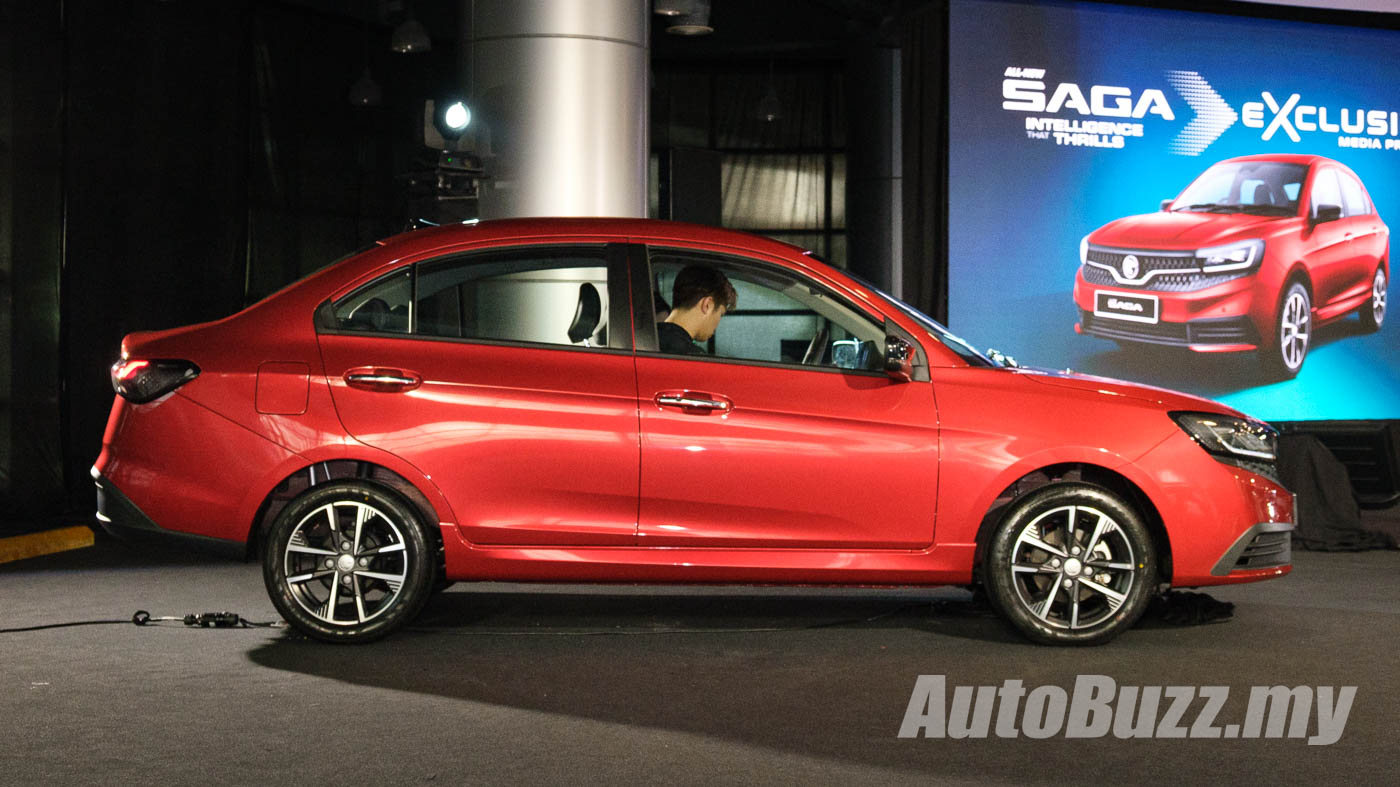
The Perodua Bezza presents a very safe and unassuming look that we Malaysians have become quite used to. The facelift in 2020 did manage to give it more character, but the rest of the car remained pretty much the same. While looks are subjective, it’s safe to say that the all-new Proton Saga looks far more composed and “up to the times” than the Perodua Bezza, which shouldn’t be too surprising since the latter is already eight years old now.
As standard, the Bezza comes with LED reflector headlights and taillights, with higher variants receiving foglights for better visibility. This pales in comparison to the Saga, as it now comes standard with projector LED headlights (automatic on Executive and higher variants), with certain variants getting integrated daytime-running lights in front. On the highest Premium variant, the Saga also comes with a full-width LED taillight at the rear, like most new cars in the past two years.
One thing both the Perodua Bezza and Proton Saga share is the option of either 14-inch or 15-inch wheels, depending on the variant. Other similar exterior features include side-mirror–mounted turn indicators, chrome door handles, and a shark fin antenna on the roof.
ALSO READ: Perodua confirms all-new model and facelift in the works – All-new Bezza, Ativa facelift in 2025?


Interior – Proton Saga wows with new tech
The Perodua Bezza comes with an analogue gauge cluster featuring a traditional multi-info display and only a 6.7-inch touchscreen headunit, even in its most premium Advance variant. In comparison, the Proton Saga offers a more modern setup with a seven-inch digital gauge cluster and a larger nine-inch centre infotainment screen for the executive and higher variants.
The Saga also supports wireless Android Auto and Apple CarPlay, while the Bezza still relies on the Smart Link app to mirror the driver’s smartphone if needed.
Running on the Atlas operating system, the Proton Saga takes the lead with support for “Hi Proton” voice commands. However, it currently works only in English, unlike some of its larger siblings, which also offer Bahasa Melayu for both menus and voice commands.

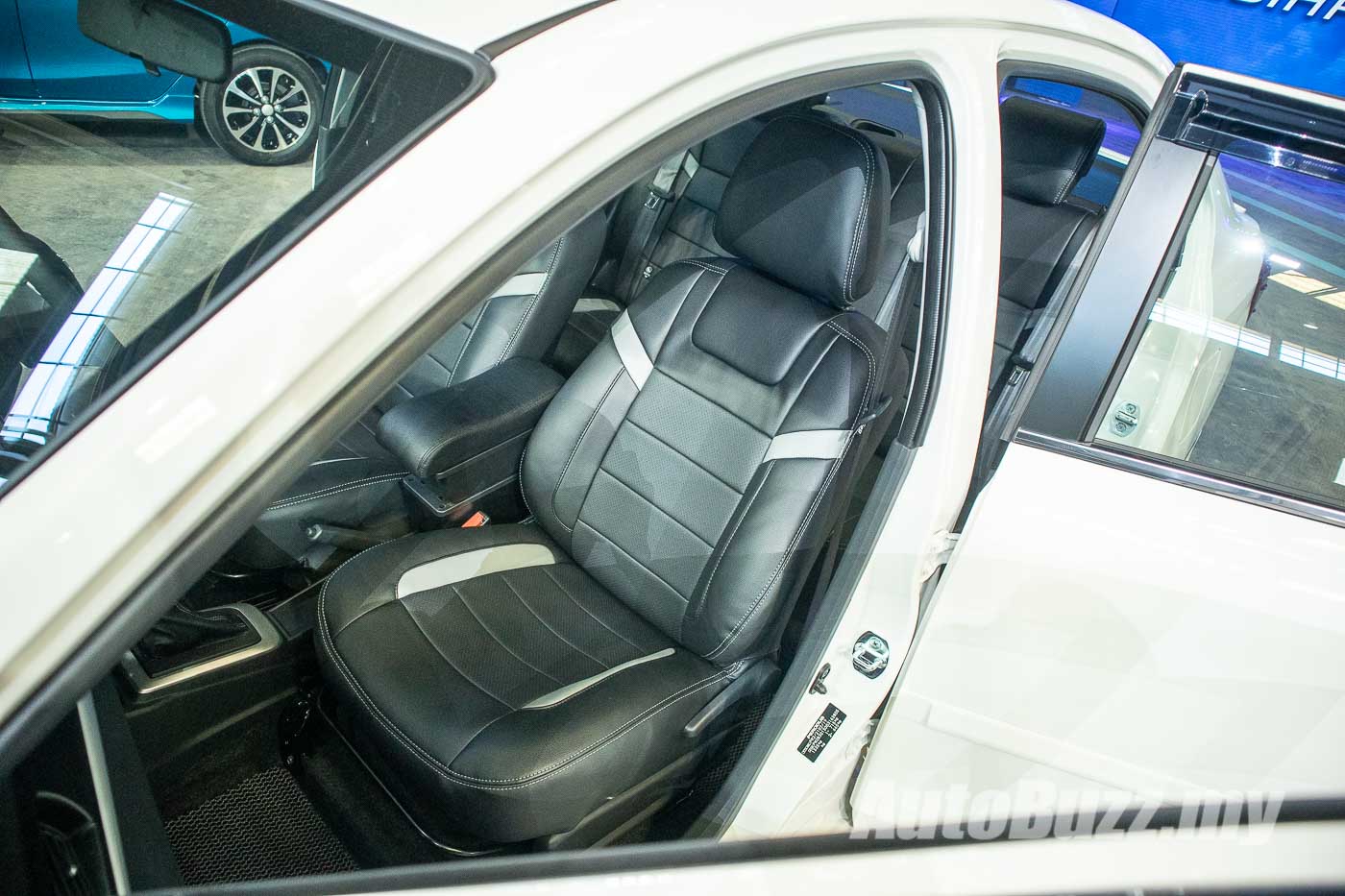
Both the Bezza and Saga offer fabric or faux leather upholstery, depending on the variant. The Saga gets an edge with up to three USB-A ports, compared to two in the Bezza. Its steering wheel, carried over from Proton’s more premium models, features tilt adjustments and additional controls, while the steering wheel in the Bezza is simpler, with fewer controls and zero adjustability.
Unsurprisingly, the Perodua Bezza’s interior feels more dated, with simple panels, large rotary climate knobs, and thick silver trims. The Proton Saga, by contrast, offers a more modern layout with intricate textures on the doors and dashboard. Admittedly, it leans a bit gloomy, with darker shades of grey and black mostly dominating the cabin.
ALSO READ: All-new 2025 Proton Saga still as hot as ever — 10k bookings in just 5 days!


Power and Fuel Efficiency – Bezza still undisputed champ in fuel consumption
The Perodua Bezza, in its highest specification, is powered by a 1.3-litre four-cylinder producing 94 hp and 121 Nm of torque. The Proton Saga, once again, outperforms the Bezza with its new 1.5-litre four-cylinder engine across all variants, pumping out 120 hp and 150 Nm of torque — 26 hp and 29 Nm more than the Bezza.
Proton boasts that its new engine – particularly the Premium variant equipped with the CVT gearbox – has seen a 14.04% improvement in fuel efficiency, coming in at 4.9 L/100 km (MDC cycle). But the Bezza, despite still using the same four-speed automatic transmission (4AT), still edges it with a fuel consumption rating of 4.8 L/100 km – or 4.5 L/100 km with Eco Idle on the range-topping AV variant.
The lower variants with the four-speed automatic sees an even lower efficiency rating at 5.1 L/100 km. That said, it’s worth noting that the Saga is using a bigger engine with more power.
A major update for the Proton Saga is its switch to a new timing chain for the engine, replacing the timing belt that has long been a point of criticism from owners. The Perodua Bezza has had a timing chain system since its launch in 2016.
ALSO READ: Tan Chong Motor to rent out assembly lines for Perodua EV production

Safety – Saga finally gets up to date
The Perodua Bezza comes equipped with the brand’s Advanced Safety Assist (ASA) 2.0 suite, offering features such as pedestrian detection (up to 50 km/h), pre-collision warning (up to 100 km/h), pre-collision braking (up to 80 km/h), front departure alert, and pedal mis-operation control. Safety equipment includes two airbags — one for the driver and one for the front passenger.
Meanwhile, the all-new Proton Saga finally catches up with a new monocular camera system mounted at the top of the windscreen, enabling a range of Level One advanced driver assistance system (ADAS) features. These include autonomous emergency braking, front departure alert, lane departure warning, and intelligent high beam.
The Saga also features a Rear Side Radar System (RSRS), adding blind spot monitoring with lane change assist, rear collision warning, rear cross traffic alert, and door opening warning. Notably, the new Saga offers six airbags and a strengthened chassis using Proton’s Reinforced Safety Structure (RESS) for improved occupant protection.
Proton boasts that the Saga is the first national model to pass the ASEAN NCAP’s new ADAS test cycle which involves motorcycle detection, but it’s likely Perodua would want to save the testing (and headlines) for its latest models instead.


Price – Saga and Bezza go head-to-head
Prices for the Perodua Bezza start at RM34,580 for the 1.0-litre G and go up to RM49,980 for the range-topping 1.3-litre AV, on the road without insurance. The Proton Saga, meanwhile, starts at RM38,990 for the Standard and rises to RM49,990 for the Premium, also on the road without insurance.
This means the entry-level Saga is RM4,410 more expensive than the equivalent Bezza, while the top-spec Saga costs just RM20 more than the range-topping Bezza.
While the Proton Saga may appear to be the stronger contender for now, it’s only a matter of time before Perodua fights back, as the next-generation Bezza is already under development.
Nevertheless, only time will tell whether the fourth-generation Proton Saga can reclaim the top spot as the nation’s preferred sedan – a title that the Bezza has enjoyed for many years.
READ MORE: All-new 4th-gen Proton Saga previewed – new 1.5L NA is 25% more powerful, 14% more fuel efficient!