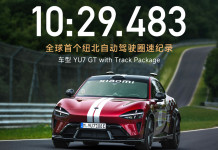
Slightly more than a year after the debut of the Xiaomi SU7, the Chinese tech giant has now finally unveiled its second vehicle, the Xiaomi YU7 in full, marking its official entry into the SUV segment – not too bad for a 15th-anniversary celebration, eh?
Essentially a raised version of the SU7, the Xiaomi YU7 shares a nearly-identical exterior design to its fastback counterpart, which some might scoff at the resemblance to a certain SUV from a very well-known Italian brand, further complemented by its McLaren-esque “waterdrop headlights,” as Xiaomi calls them.

Nevertheless, there are still several unique design elements to differentiate it from its sedan sibling. These include blacked-out wheel arches, completely flush door handles, redesigned full-width C-shaped taillights, and what Xiaomi claims to be the world’s largest clamshell aluminium hood for a mass-production vehicle.
Dimension-wise, the Xiaomi YU7 measures 4,999 mm long, 1,996 mm wide, and 1,600 mm tall, with a 3,000 mm wheelbase. For comparison, this makes the YU7 slightly longer, wider, and – obviously – 145 mm taller than the SU7, with both models sharing the same wheelbase.
RELATED: The Xiaomi SU7 already has its first clone

The differences between the two are more apparent inside, taking full advantage of the Xiaomi YU7’s taller sillhouette. For starters, while the SU7 sports a digital gauge cluster in a conventional placement behind the steering wheel, the YU7 instead boasts a large 1.1-metre-wide, end-to-end panoramic display nestled underneath the front cowl above the dashboard.
Xiaomi calls this expansive screen the “Xiaomi HyperVision Panoramic Display.” It features five modular information categories, providing drivers with optimally positioned speed and navigation projections in their natural sight lines. This is accompanied by a more conventional centrally mounted 16.1-inch touchscreen infotainment display.

Seats are different, too. the Xiaomi YU7 boasts dual zero-gravity front seats for both driver and passenger, complete with massage function. For rear passengers, the seats can recline to a 135-degree lounge position from a standard 100-degree angle. Additional creature comforts include dual rear entertainment displays.
As an SUV (no funny names here, thank heavens), practicality is a key highlight of the Xiaomi YU7, offering a total storage capacity of 1,970 litres. This includes a 141-litre frunk and a 678-litre rear boot space, which expands to 1,758 litres with the rear seats folded. Within the cabin, Xiaomi states that interior storage compartments provide an additional 71 litres of capacity.

The Xiaomi YU7 is slated for launch in China in three variants: a base YU7, the Xiaomi YU7 Pro, and the Xiaomi YU7 Max. The base YU7 is powered by a rear-mounted electric motor delivering 320 hp (235 kW) and 528 Nm, achieving 0-100 km/h in 5.88 seconds and a top speed of 240 km/h.
Stepping up to the Pro variant, the SUV gains a front-mounted electric motor for an all-wheel drive (AWD) setup that delivers 496 hp (365 kW) and 690 Nm. This reduces the 0-100 km/h sprint to 4.27 seconds, although it maintains the same top speed as the base variant.

The Max variant is the most powerful of the trio, boasting a 690 hp (508 kW) and 866 Nm AWD powertrain capable of propelling the YU7 to 100 km/h from a standstill in 3.23 seconds, onward to a top speed of 253 km/h. Another exclusive feature of the Xiaomi YU7 Max variant is the four-piston Brembo brakes to keep all the 690 horses in check.
Other highlights of the Xiaomi YU7 include a continuous damper control system and a closed dual-chamber air suspension, equipped on the Pro and Max variants. This air suspension supports five levels of height adjustment, offering a maximum vertical adjustment range of 75 mm and a maximum ground clearance of 222 mm.

For batteries, the base and Pro Xiaomi YU7 models are equipped with a 96.3 kWh battery pack. This provides a range of 835 km for the base YU7 and 770 km for the Pro variant, according to the more-lenient CLTC test cycle. The Max variant features a larger 101.7 kWh battery pack, enabling a range of 760 km (CLTC).
In terms of charging, the Xiaomi YU7 is built on an 800-volt architecture. Xiaomi states the YU7 can support a maximum charging rate of 5.2C. In China, the C-rating indicates the charging speed of an electric vehicle’s battery in the context of how many times the battery can be fully charged within an hour.
A 1C charge rate means a battery can be fully charged in one hour, while a 2C rate means it can be fully charged twice in an hour. For the Xiaomi YU7, its 5.2C rating allows it to be recharged from 10% to 80% in just 12 minutes, and regain 620 km of range with 15 minutes of charging.

For safety features, the Xiaomi YU7 chassis is built with Xiaomi’s 2200 MPa high strength steel, which the company says was developed using Xiaomi’s AI algorithms. Additionally, the YU7 is equipped as standard with a suite of ADAS features that is based around a LiDAR unit and 4D millimeter-wave radar, powered by the new generation Nvidia Drive AGX Thor in-vehicle computing platform.
With CarNewsChina reporting that the Xiaomi YU7 will officially launch in China in July 2025 with an estimated price of RMB199,000 (approx. RM117k), the question arises: will the YU7 achieve the same massive popularity as its sibling, the Xiaomi SU7, which hit its annual sales target of 10,000 units within just two hours of its launch?
ALSO READ: Porsche EV sales in China is so bad, the company might stop selling them entirely
GALLERY