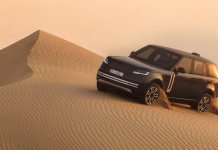
After tackling the scorching heat of the United Arab Emirates desert, the Range Rover Electric is now facing the frigid winters of the Arctic Circle as part of its winter testing program.
The Range Rover Electric is Jaguar Land Rover’s (JLR) second all-electric model and is almost visually identical to its internal combustion counterpart. The blocked-off front grille, a redesigned charging port flap, and aerodynamic-focused alloy wheels are among the noticeable differences.

Previously reported information suggests that the Range Rover Electric will offer similar performance to the Range Rover SV; powered by a 4.4-litre V8 producing 615 hp and 750 Nm in the P615 configuration. This indicates that the Range Rover Electric will likely feature a dual-motor setup, or potentially even a quad-motor powertrain configuration.
For battery packs, based on press materials provided by JLR, the Range Rover Electric will utilise a 118 kWh battery pack, consisting of 344 prismatic cells in a double-stacked layout built on an 800V architecture. It’s the first one to be designed and built in‑house at JLR.
RELATED: Range Rover Electric tackles the desert heat in latest development tests

While JLR did not provide specific details regarding range or charging times, they confirmed that the Range Rover Electric will be all-wheel drive and feature single-pedal driving and switchable twin-chamber air suspension.
According to JLR, this single-pedal driving capability can bring the Range Rover Electric to a complete stop and has been tested in challenging terrains, including 28-degree and 17-degree inclines at the Arctic test facility.
Making the most of the frigid weather conditions, JLR is also testing the Range Rover Electric’s new ‘ThermAssist’ technology, an onboard thermal management system designed to reduce heating energy consumption by up to 40% and recover heat to warm the powertrain or cabin in ambient temperatures as low as -10°C.

This advanced heat management technology ensures the Range Rover Electric delivers an optimised driving range, even in the coldest temperatures. It also helps with minimising the impact of extreme temperatures on charging performance, a common challenge for EVs in both very hot and cold climates.
Furthermore, JLR is also putting the Range Rover Electric’s Intelligent Driveline Dynamics (IDD) technology through its paces. The IDD system, working in conjunction with the Integrated Traction Management, can maintain optimal traction by controlling motor speed within 50 milliseconds and managing wheel slip up to 100 times quicker than a comparable internal combustion engine (ICE) vehicle.
The Range Rover Electric will continue its rigorous testing and development program ahead of the commencement of client reservations, which are slated to begin in 2025, as we reported previously.
ALSO READ: 2025 Land Rover Defender V8 launched in Malaysia – Priced from RM998k before duties
GALLERY