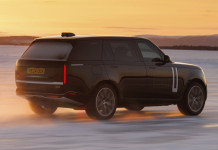
After months of testing in climates ranging from scorching desert heat to frigid winters, the debut of Jaguar Land Rover’s (JLR) second all-electric model is upon us. Our media peers at Autocar in the UK have had the first spin in the new Range Rover Electric, and new details have emerged.
First things first: the powertrain. We now know that the Range Rover Electric will be powered by a dual-electric motor setup, with one motor on each axle. The combined output is rated at 542 hp and 850 Nm of torque. While the official 0-100 km/h time is unconfirmed, the publication quotes a time of around 4.5 seconds.

For comparison, this is 73 hp less powerful than the current Range Rover SV P615’s 4.4-litre V8, but the EV version produces a substantial 100 Nm more torque than the V8 can muster.
The two electric motors will be powered by JLR’s first in-house designed and built 118 kWh nickel-manganese-cobalt (NMC) battery pack, enabling a range of 483 km, with JLR keeping the charging specifications close to its chest until the official debut.
The elephant in the room, quite literally, is the kerb weight. JLR did not disclose the actual figure but is aiming for the SUV to tip the scales at around 2,800 kg. While heavy, this is only about 100 kg more than the plug-in hybrid (PHEV) variants.
RELATED: Range Rover Electric with 118 kWh battery – the first designed and built in-house

To manage this weight, the Range Rover Electric will be equipped with a twin-chamber air suspension adopted from the Range Rover Sport. Thanks to its battery pack providing a lower centre of gravity than any other Range Rover models, the company claims the EV variant has “superior ride quality” and makes do without the active anti-roll bars found on the standard models.
However, like all things, there are compromises. The primary one is that the Range Rover Electric will not be offered as a seven-seater, as the EV powertrain takes up underfloor space.

The towing capacity also takes a hit, with the EV rated at 2.5 tonnes compared to the 3.5 tonnes on the standard ICE-powered Range Rover. Despite this, JLR still plans to offer both standard and long-wheelbase variants at launch.
Another compromise is that the Range Rover Electric’s ground clearance is slightly lower than its non-EV siblings (260 mm vs. 290 mm), and its breakover angle is also reduced (23 degrees vs. 27 degrees).

For off-road fans (though who really takes their Range Rover off-road?) the good news is that the 900 mm wading depth is unchanged. It also boasts a 45-degree climbing capacity. The compromises in this area are a slightly lower ground clearance at 260 mm, and a break-over angle of 23 degrees.
Despite being electric, it seems the whisper-quiet Range Rover is already garnering significant interest. The publication reports that JLR has received 60,000 “firm expressions of interest” in the SUV, which translates to over a year’s worth of production volume. While the official sticker price has not been revealed, sources are quoting a price point of under GBP150,000 (approx. RM885k).
ALSO READ: After 55 years, Range Rover finally gets its own logo – but you probably won’t see it on their cars