The current “ND” generation Mazda MX-5 debuted globally in 2014, and even after 11 years, the Miata still remains highly popular. Still, 11 years is an extraordinarily long time in the automotive industry, and the next-generation model will most likely be coming very soon.
Rumours for the next-gen MX-5 are already out in full swing, with some suggesting it to incorporate some form of electrification, as the world marches on forward with the phasing out of internal combustion engines (ICE). Mazda, however, has now confirmed that it intends to continue powering the MX-5 with petrol engines for as long as possible, retaining its naturally aspirated character and offering it with a manual transmission – welcome news for clutch pedal enthusiasts.

Speaking to Road and Track, Mazda Chief Technical Officer Ryuichi Umeshita said that the next-generation Mazda MX-5 will stick to its tried and true lightweight recipe, and will be powered by a 2.5-litre naturally aspirated engine.
The new 2.5-litre engine is likely to be from Mazda’s Skyactiv-Z lineup, slated to debut in the all-new Mazda CX-5 in 2027. This engine family is designed to meet strict global emission standards by utilising the Lambda cycle.
In simplified terms, the Lambda cycle is a highly efficient combustion process that adjusts air intake valves to optimise combustion. This leads to a fuel-efficient engine with reduced emissions.
RELATED: 2025 Mazda MX-5 launched with 35th Anniversary Edition in Malaysia, from RM295k

That said, don’t get your hopes up for a power boost from the new 2.5-litre engine, because Umeshita has made it clear that’s not happening.
Umeshita explains, “The current power-to-weight ratio is enough. We don’t think we need more power for the car, because we can fully utilise and enjoy the capability and capacity of the engine already.”
“So my answer is that we are not planning to add more power to that car. Basically, this is the concept that keeps the car very unique,” Umeshita adds.
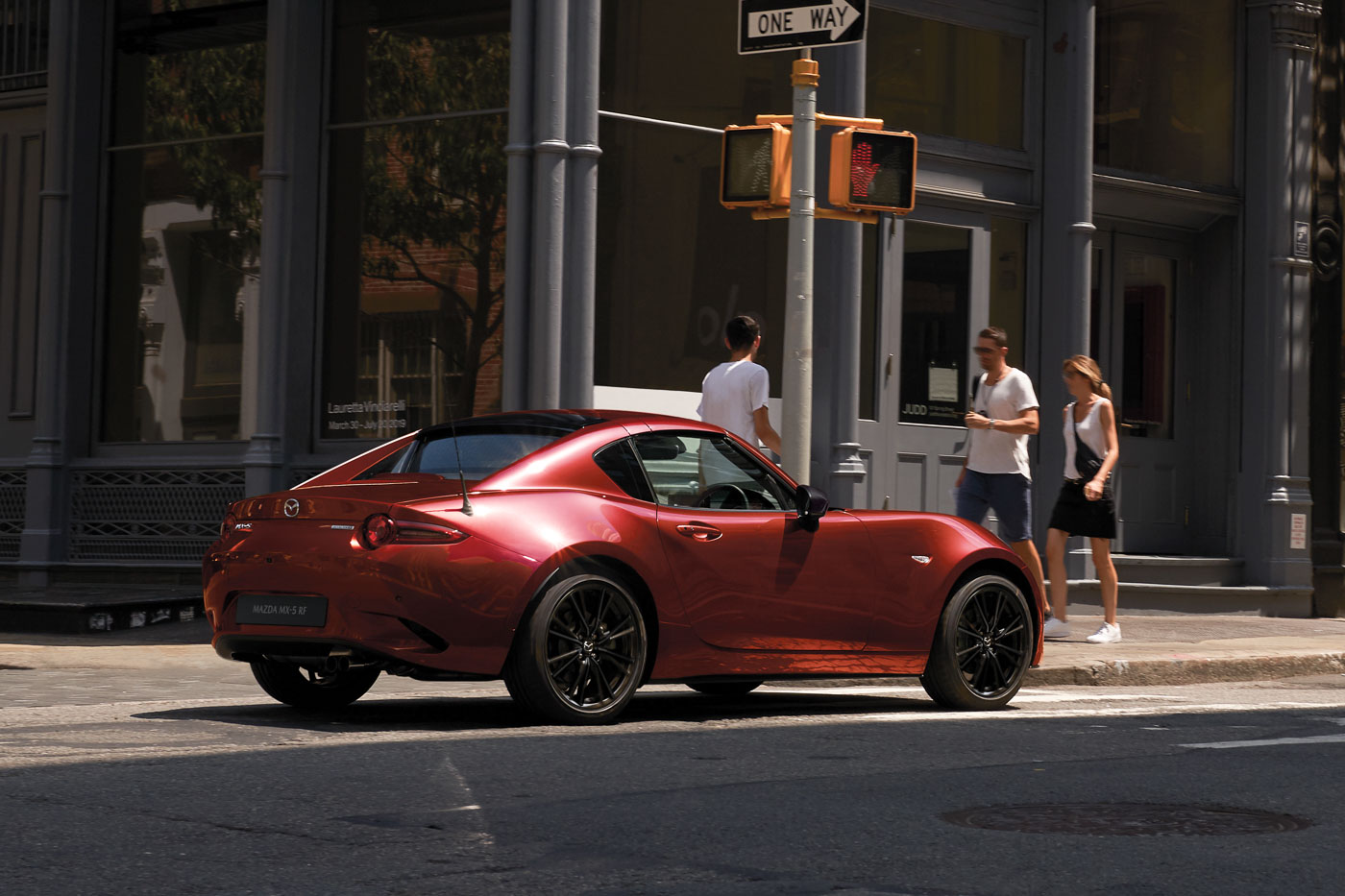
The larger engine (compared to 1.5- and 2.0-litre naturally-aspirated mills in the ND generation), will definitely bring on more weight. But Mazda thinks it will still be able to maintain a weight of below 1,000 kg on the next-gen model, alongside its signature compact footprint of under four metres in length.
Umeshita explains that there has been market pressure from certain regions to make the car bigger and more powerful, but Mazda is hell-bent on keeping to its strict recipe for the MX-5, which – to be fair – has proven to be successful so far.
“What defines the MX-5?” he asked. “I would say the most important thing is that it is lightweight, and that the second most important thing is that it is lightweight. That is the key — whatever the future MX-5 is, it must be very light.”
RELATED: Japan’s carmakers turn to synthetic fuels to keep engines alive – 1st public test in Expo 2025

Still, when electrification is inevitable, Mazda will definitely be considering a fully electric MX-5. But the company emphasises that a fully-electric (EV) version will be a last resort, to be pursued only if internal combustion engines are banned.
Umeshita adds, “and of course, our engineering team is studying both ways – battery EV and ICE Miata (MX-5). But whatever we do, the ICE one is lighter.”