Quantifying something tangible is decidedly easy. If you can touch it, odds are you can count it by some metric as it is objective. Trying to gauge something subjective can be a little trickier though, such as vehicular safety.
Sure, you can count the airbags and number of safety features but the very subjective nature of vehicular accidents means that you cannot just put a number on how “safe” a vehicle is. Nonetheless, crash testing mechanics have come a long way and the methods of evaluating a vehicle’s safety have grown more detailed in informing consumers on the safer car.
If you thought that the best way to determine a vehicle’s safeness is to actually crash it, you wouldn’t be a dummy. Well, at least not the crash test dummies that take one for the team.

And who has the cool job of intentionally crashing cars with said dummies in them? Those lucky sods are the ASEAN NCAP (New Car Assessment Programme) organisation.
Its primary purpose is to encourage safer vehicles from carmakers and subsequently conduct crash impact testing before translating the data into information that is easily understood by consumers to make informed decisions.
Furthermore, with the long-term goal being the continuous development of vehicle safety, the organisation gradually amends the targets for higher ratings with more stringent requirements to nudge carmakers towards selling safer vehicles not just for occupants but for other road users as well.
RELATED: Chery Omoda 5’s 88.64 score is highest ever in ASEAN NCAP crash tests

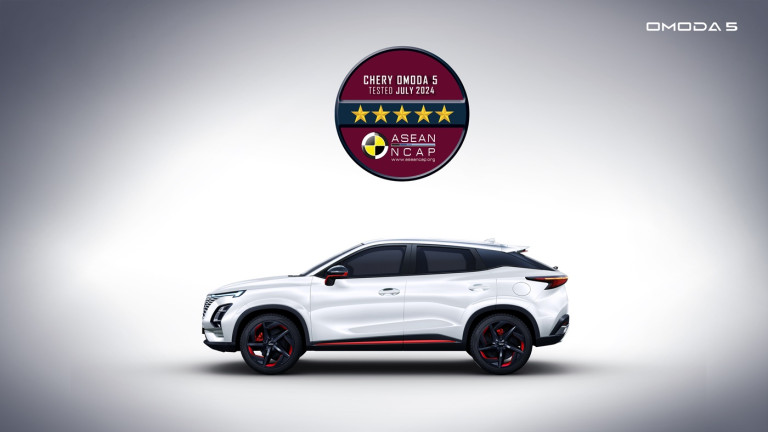
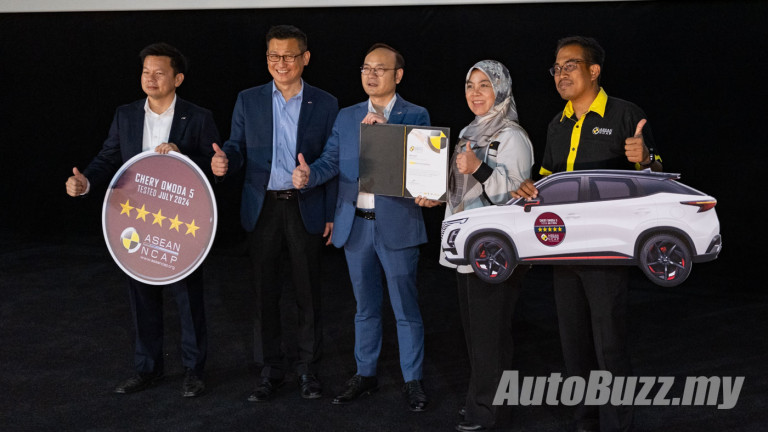
An impactful example, pun intended, would be the most recent vehicle they tested; the Chery Omoda 5. Not only did it score the maximum 5-stars, its array of active and passive safety features saw it record the highest score in the history of ASEAN NCAP tests (2021-2025 test protocol), indicating that carmakers continue to strive for safer vehicles.
They conduct themselves with the region’s interests in mind and its initial phase, the ASEAN NCAP Roadmap 2021-2030, comprises four pillars in the name of improving safety for road users:
- Adult Occupant Protection (AOP)
- Child Occupant Protection (COP)
- Safety Assist (SA)
- Motorcyclist Safety (MS)
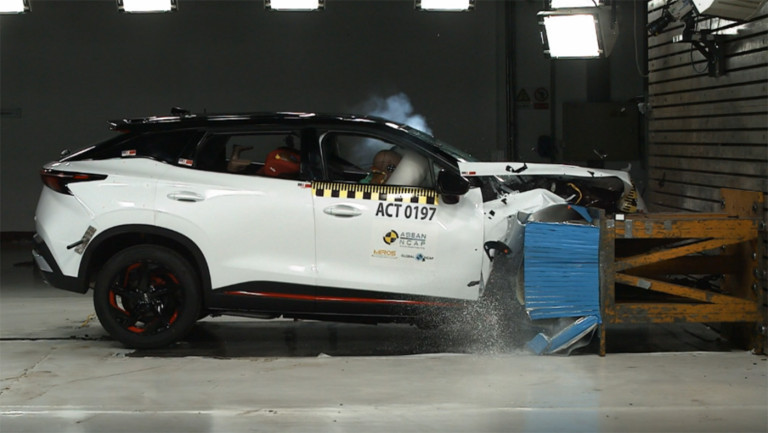
Adult Occupant Protection
AOP maintains two assessments, frontal and side-impact. However, ASEAN NCAP has reduced the scoring percentage for side impact and will instead award points for Head Protection Technology (HPT). This will encourage carmakers to include more curtain airbags in their models.
Child Occupant Protection
ASEAN NCAP is one of the first NCAP’s aside from the more stringent Euro NCAP to encourage improved child safety in vehicles. It did so by introducing Child Presence Detection technology for a child left unattended in the car and will continue to push for better child protection in cars.
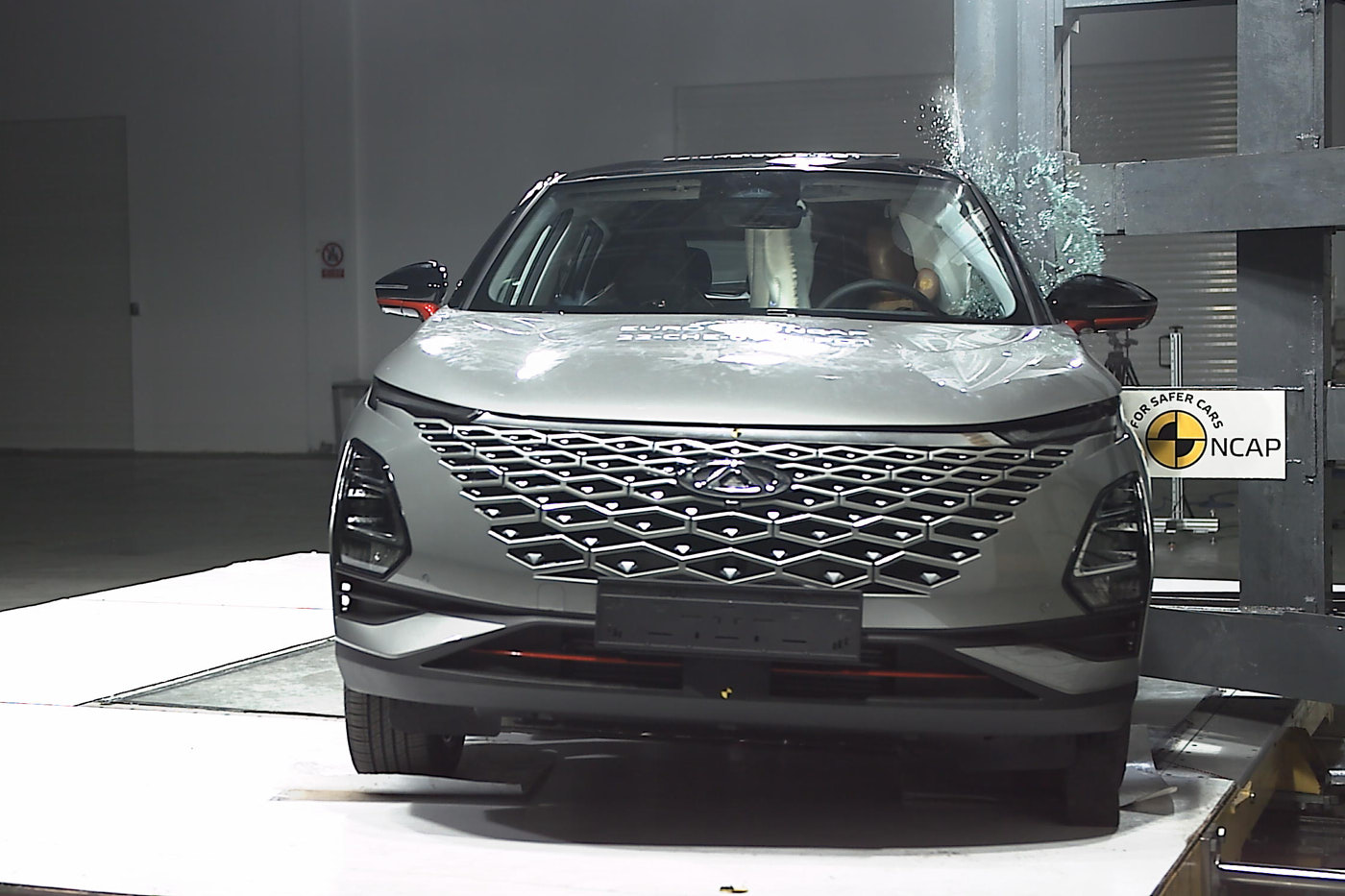
Safety Assist
A strong passenger cell is cardinal in preventing injuries but what if the vehicle could prevent an accident from happening in the first place? That is the logic behind Advanced Driver Assistance Systems such as Autonomous Emergency Braking (AEB). The split-second difference of the AEB system applying the brakes before the driver could be all the difference between a fender bender and a heavy impact. One of ASEAN NCAP’s most recent examples is the Chery Omoda 5 that features AEB as standard, undoubtedly playing a part in the SUV achieving the highest score in the history of ASEAN NCAP tests.
Motorcyclist Safety
The humble ‘kapchai’ remains the backbone of personal transportation for a majority of Southeast Asians, making up 80 percent of road users in the region, and is unfortunately statistically more prone to being involved in accidents. To protect other road users, ASEAN NCAP has placed an emphasis on motorcyclists’ safety on its agenda.
RELATED: Here’s your first official look at the 2024 Chery Omoda 5 facelift!
Since its inception, one in ten cars within the region have been rated and at least 90 percent have scored a rating of 4 or 5 stars, a strong indication the roadmap is keeping the region on course towards safer motoring.
The aforementioned Chery Omoda 5 is one of the best examples of this. Many cars have been awarded the maximum 5-star rating but to achieve the highest score yet takes an intelligent combination of various aspects.
Working together, the Chery Omoda 5 netted a rating of 88.64 points to sit atop the ASEAN NCAP honour roll. To break it down, the SUV scored 17.36/20.00 points for COP, 19.51/20.00 points for S, 15.00/20.00 points for MS and 36.77/40.00 points for AOP.
It can count on passive safety features such as ABS, EBD, Brake Assist, Electronic Stability Program (ESP), Traction Control (TC), Hill-Start Assist Control (HAC), Hill Descent Control (HDC) and not forgetting the Tire Pressure Monitoring System (TPMS) among its standard fare for the occupant’s safety.
Crucially, the edge over other 5-star vehicles is courtesy of the extensive Level 2 Advanced Driver Assistance Systems (ADAS) that are standard. Making up the list are Lane Departure Warning (LDW), Blind Spot Monitoring (BSD), Rear Cross Traffic Alert (RCTA), Adaptive Cruise Control (ACC) with Low-Speed Follow (LSF), Forward Collision Warning (FCW), Lane Keep Assist (LDP) and Traffic Jam Assist (TJA).
Some drivers may lament the occasional intrusiveness of active safety features but theres no denying that it is better to have it and not need it than to need it and not have it.