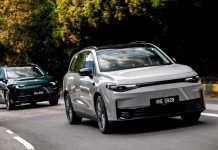
Stellantis Malaysia has announced an over-the-air (OTA) update for the Leapmotor B10, arriving six months after the model was launched locally. This 2026 software release began rolling out to owners in early February, with drivers notified directly via the car’s interface as the installation becomes available for their specific vehicle.
The update introduces one-pedal driving, which allows the driver to control acceleration and braking primarily through the accelerator pedal. This feature includes revised energy recovery logic intended to provide smoother control and improved efficiency.
Connectivity is also expanded to include Apple CarPlay and Android Auto, both of which are now available via wired or wireless connections for the 14.6-inch infotainment display.

Interior and interface changes include new multifunction settings that allow drivers to personalise steering wheel buttons with shortcuts for ADAS features and drive modes. The infotainment system now boots faster due to a “Quick Start” preloading feature, and the in-vehicle life presence detection reminder has been optimised.
Additionally, Leapmotor has tuned the adaptive cruise control (ACC) and lane centering Control (LCC) to ensure smoother deceleration when the B10 approaches curves.
The Leapmotor B10 is available in Malaysia in two variants: Life and Design, priced from RM108,500 and RM119,500, respectively, on-the-road, without insurance. Both variants use the same powertrain, featuring a single rear-mounted electric motor delivering 218 hp and 240 Nm, enabling 0-100 km/h in 8 seconds and a top speed of 170 km/h.
RELATED: 2025 Leapmotor B10 launched in Malaysia – C-segment EV SUV, 2 variants, from RM108k

Primary differences between the variants lie in battery capacity and charging speeds. Opting for the Life variant provides a 56.2 kWh lithium iron phosphate (LFP) battery with up to 361 km of WLTP range. This model supports 11 kW AC charging, taking 2.5 hours to charge from 30-80%, and DC charging at 140 kW.
Stepping up to the Design variant sees it equipped with a larger 67.1 kWh LFP battery, increasing the WLTP range to 434 km. While AC charging remains at 11 kW, taking three hours for a 30-80% charge, DC charging is increased to 168 kW. Despite these differences, both variants share a 30-80% DC charging time of under 20 minutes and include a 3.3 kW vehicle-to-load (V2L) function.