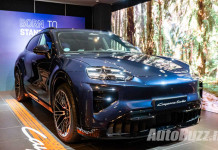
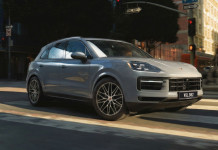
The upcoming electric Porsche Cayenne will soon launch with an optional wireless charging system — making it the first production car in the world to offer the feature. But how fast is it? Is it safe? And why hasn’t anyone done it before? Ahead of its global debut, Porsche is now finally explaining how the system works.
With confidence, the company said, “Soon there will be no need for charging cables, wallboxes, or manual involvement — simply park the car in the garage and charging will begin.”

The wireless charging system consists of two major components: A floor plate module for the garage or parking space, and a receiver unit located behind the front axle of the car. To charge it, the driver will just need to line the car up centrally with the charge plate.
A helpful SUrround View camera with guidelines appears on screen to help drivers line up their car. A green dot shows the position of the receiver, while a green circle represents the wireless charging coil. When the dot sits inside the circle, the car is correctly positioned and charging can begin. Two sensors in the vehicle communicate with four units in the floor unit.


The wireless charger can transfer up to 11 kW of power wirelessly with up to 90% charging efficiency, even while being 12 to 18 cm away from the floor plate. Porsche says charging power and time using this new system will be similar to those of a more traditional wallbox connected via cable and plug.
Speaking of which, the housing of the floor charge plate contains everything it needs, eliminating the need for an additional wallbox. Only needing a connection to a power supply, it has its own Wi-Fi connection to communicate with the car, including the use of a password, which protects the customer from electricity theft from non-authorised users. Altogether, the unit measures six cm in height, 78 cm in width, and 117 cm in length.
ALSO READ: The electric Porsche Cayenne has a battery cooling system as powerful as 100 fridges

Just like the wireless charging pads for your phone, Porsche’s wireless charger relies on “inductive coupling,” where two copper coils face each other. Electricity flowing through one coil creates a magnetic field that induces voltage in the second coil — transferring energy without physical contact. Despite the same physics principles, though, Porsche engineers had to scale it up for automotive use, making it larger, more powerful, and still safe and efficient.
AC power from the grid is first converted to DC in the floor plate because the system doesn’t use the usual 50–60 Hz found in homes. It then switches back to high-frequency AC at 85 kHz (85,000 Hz) and about 2,000 volts, allowing energy to flow efficiently to the car. Porsche explained that this allows energy to be transferred even if the vehicle isn’t perfectly positioned, with a misalignment of up to 10 cm between the floor plate and the receiver module still allowed.
ALSO READ: Malaysia launches ASEAN’s first “EV battery passport” standard

With so much power being dealt with, it could spell danger if not handled in a controlled manner. The receiver plate is embedded in a shielding plate that prevents the magnetic field from spreading upward and protects the vehicle’s components. Ferrites, a type of ceramic compound, are placed beneath the coil in the floor plate and above the receiver coil to guide the magnetic flux.
The floor plate also includes a foreign-object detection system to spot metallic items like keys, and a live-object detection system using motion sensors to protect pets or people reaching under the vehicle. Porsche Charging Equipment Product Manager Simon Schulze explains that the high voltage could cause any nearby metal to heat up, similar to an induction stove. Its built-in safety systems ensure this doesn’t occur.

Porsche Head of Charging Systems, Christian Holler, said, “Porsche is currently the only car manufacturer in the world that is going to offer contactless charging, with an innovative 11 kW one-box system.”
Moving forward, Porsche aims to refine the wireless charging experience further. Having already removed the need for manual plug-ins, the company now plans to take automation even further. In the future, Porsche wants drivers to simply stop in front of their garage or porch, press a button, and let the car park itself over the charger — much like a home robot vacuum docking at its station.
ALSO READ: The all-new electric Porsche Cayenne’s interior is a techie’s dream come true
GALLERY