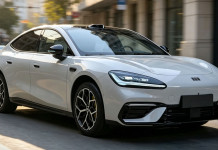
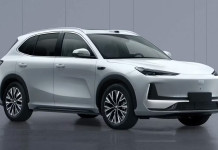
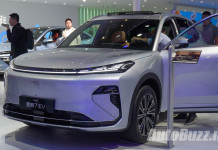
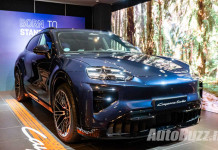
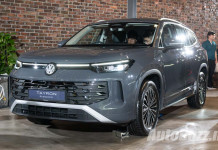
The Geely Galaxy Starship 7, the plug-in hybrid (PHEV) counterpart to the fully electric (EV) Geely Galaxy E5 (known as the Proton eMAS 7 in Malaysia), is on display at Geely’s booth at the Shanghai Auto Show 2025. In China, the Starship 7 is available in five variants, priced from RMB97,800 (approx. RM59k) to RMB130,800 (approx. RM79k).
Based on the “Global Intelligent New Energy Architecture” (GEA), the Geely Galaxy Starship 7 stretches out to 4,740 mm long, 1,905 mm wide, and stands 1,685 mm tall, with a wheelbase of 2,755 mm. That makes the Starship 7 a tad longer, wider, and taller than the Galaxy E5, and it’s got a slightly longer wheelbase too.

Externally, the Geely Galaxy Starship 7 shares an initial resemblance with the Galaxy E5, but a closer look reveals subtle differences between the two SUVs. The Starship 7 features full-width daytime running lights (DRLs) at the front, with the headlights integrated into the front bumper.
Peeking at the side profile, the Geely Galaxy Starship 7 opts for conventional door handles, a contrast to the flush ones on the Galaxy E5. A key difference on the Starship 7 is the missing charging flap on the right front fender, which is present on the Galaxy E5. In turn, the Starship 7 features two flaps on both rear sides, presumably for the fuel and charging ports.
Spin around to the back, and the full-width taillights on the Geely Galaxy Starship 7 look similar to the Galaxy E5. There’s a slight twist: the lower part of the Starship 7’s taillight is blacked out, while that same area on the Galaxy E5 is red. Another key difference is the number plate location – it sits on the tailgate of the Starship 7, whereas the Galaxy E5’s is on the rear bumper.
RELATED: Geely Starship 7 PHEV unveiled with 1,430 km range – could this be Proton’s first PHEV?

The family resemblance to the Geely Galaxy E5 is clear inside the cabin of the Galaxy Starship 7, sporting a familiar layout. You’ll find a centre 14.6-inch touchscreen infotainment system running on the Flyme OS operating system, along with a driver’s 10.2-inch digital gauge cluster that’s complemented by a 13.8-inch heads-up display (HUD).
Other interior features of the Geely Galaxy Starship 7 include a 50W ventilated wireless phone charger, a 16-speaker Flyme sound system with headrest speakers, and rear air conditioning vents. The top variant of the Starship 7 adds 256-colour ambient lighting and heated, ventilated, and massaging front seats, and a panoramic sunroof with sunshade.

The Geely Galaxy Starship 7 PHEV powertrain consists of a 1.5-litre engine producing 111 hp and 136 Nm of torque. This is paired with an “E-DHT Intelligent Stepless 11-in-1 Hybrid Electric Drive” transmission that houses an electric motor delivering 218 hp (160 kW) and 262 Nm, which drives the Starship 7.
Two lithium-ion phosphate (LFP) battery packs are offered for the Geely Galaxy Starship 7. The base variants feature an 8.5 kWh battery pack with a rated EV range of 55 km (CLTC).
The other battery pack is Geely’s Aegis blade battery with 19.09 kWh, providing a longer EV range of 120 km (CLTC) and supporting DC fast charging at 36 kW, enabling a 30% to 80% recharge in 20 minutes.

Standard safety features of the Geely Galaxy Starship 7 include a “God’s eye 540-degree transparent chassis camera, six airbags, and a tyre pressure monitoring system (TPMS).
The higher-end variants of the Starship 7 is equipped with a comprehensive suite of advanced driver assistance systems (ADAS) for enhanced safety. These include intelligent cruise control (ICC), adaptive cruise control (ACC) with stop and go functionality, traffic jam assist (TJA), and traffic sign recognition (TSI).

The big question now is whether the Geely Galaxy Starship 7 will arrive in Malaysia as an eMAS model. While uncertain, it’s a possibility, especially considering Proton’s new EV production facility in Tanjung Malim, where the eMAS 7 will be locally assembled by end of 2025.
Proton has also confirmed plans to CKD two other GMA platform-based models (the same GEA platform as the Starship 7), one likely a compact hatchback based on the Geely Xingyuan, and the other potentially the Starship 7, though Proton’s dedicated EV factory plans might rule out the PHEV Starship 7, but in the fluid world of the car industry, plans can always change accordingly.
ALSO READ: Proton breaks ground on RM82m EV factory – eMAS 7 production to begin end-2025
GALLERY