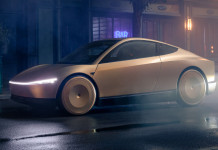
It’s finally here: Tesla’s – or rather Elon Musk’s – bold idea of what the future of mass transportation will look like… Or is it? Well, an event for the Cybercab (or Robotaxi, according to a single social media post… We’re not entirely sure) definitely did happen, but we feel it’s our responsibility to remind you that – whatever Tesla showcased in the “We, Robot” livestream yesterday is still not real, or at least, not yet. In fact, it probably won’t become real for a long time to come, and even then, expect to see some goalposts being moved.
You don’t have to look much further than the Tesla Cybertruck to see what we mean. When the divisive EV pickup was first unveiled back in 2019, a younger Elon Musk told audiences on stage that the Tesla Cybertruck will be available starting from 2021, priced from just USD39,900 (approx. RM171k). Now five years later in 2024, that “affordable” variant is still nowhere to be seen, and according to Tesla, it will not be seeing the light of day either, for the time being at least.

Yes, there’s the all-wheel drive variant and something called the Cyberbeast, but prices now start at USD99,990 (approx. RM429k), and that’s not the only thing that has changed either. The Tesla Cybertruck’s range claims also fell from a frankly absurd 500-mile EPA estimate to now a more realistic 340 miles (545 km) on the longest-range variant – a massive 32% drop from what Musk once said.
And don’t get us started on the yet-to-be-launched Tesla Roadster, which was supposed to be available four years ago now. Tesla is still happily collecting USD5,000 (approx. RM21k) pre-booking fees for that, by the way – which you’ll have to append with another USD45,000 (approx. RM193k) in 10 days to confirm your reservation. Oh, anyone remember the supposedly “Full Self Driving” (FSD) feature that was supposed to be available by 2016, no – 2021? Or was it 2023? Heck, there’s even a Wikipedia page just to track Musk’s inaccurate autonomous driving claims.
ALSO READ: One million self-driving Tesla cars by 2020, claims Elon Musk

Look, we’re sure Tesla engineers are doing good work, and there’s no reason to believe that the Cybercab – or whatever it’s called – won’t be technically possible. A steering wheel-less car driven entirely by a computer, one with 10 times the processing power of their current “Hardware 4.0”? Sure, we believe it, as such is the pace of technology advancements these days.
Even today, there are already multiple “self-driving” prototypes and rolling test labs running around various city streets. Some of them are now even running as a commercial transport service, like Google’s Waymo in California – just without the same flashiness as Musk’s concept of a robotaxi. In fact, it was Musk himself who said that the autonomous driving problem is basically “solved”.

The problem for a fully autonomous taxi is perhaps not so much a technical one, but rather of regulatory, and perhaps most importantly, pricing. And even if Tesla really did find a way to sell the Cybercab for under USD30,000, getting government approvals would likely be the biggest roadblock the American carmaker will face trying to hit their proposed “by 2027” timeline.
And then, of course, you’ll have to get the insurers on board, because someone has to take liability when the Cybercab inevitably crashes. Then, the first responders (firefighters, first aid) and financiers to make the whole share-your-car idea work. And that’s really only scratching the surface. There are really a lot of things an aspiring robotaxi operator should worry about, as autonomous ride-sharing service Cruise’s ex-CEO and co-founder, Kyle Vogt, shared on X (formerly Twitter).

Yesterday’s We, Robot event was, frankly, nothing more than smoke and mirrors – an event designed to drum up hype, in hopes (we think) of boosting investments via the stock market. Tesla did not add anything to the conversation that we did not already know about, and for all the promises that Musk made on stage at the event, there really wasn’t much in terms of actual details.
How far along are we at in terms of FSD development – a technology that the Cybercab clearly relies on? Where can the Cybercab actually operate autonomously? And will the people who paid for FSD in their Tesla Model 3 and Model Y actually be getting what they were promised? And before you ask “what about the prototypes shown during the event?”, know that Tesla has at least at one point in time trained their FSD Beta software on specific routes their “VIP” influencers take, just so it shows up better on videos…

Tesla certainly has a lot riding on the Cybercab becoming a reality – they’ve even cancelled their “even more affordable” mass-market vehicle to make it happen, and that so-called Model 2 was penned as far back as 2006 in Elon Musk’s first “Master Plan” for the brand.
The Cybercab project is probably the singular most important product Tesla can make since Musk took over the company, and we’re sure the brilliant minds at the company are trying their damnest to make it work. All we’re saying is, we won’t be holding our breath.
RELATED: Tesla teases 3 new models, to include more affordable offerings?
GALLERY