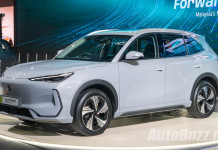
Following its first public debut at the ASEAN Summit recently, Proton has now official revealed key information of the all-new Saga, along with full hi-res, uncamouflaged images, giving us our first proper look at the Malaysian people’s car ahead of its launch – which is rumoured to happen sometime this month.
Now coming into its fourth generation, the entry-level sedan has been given a significant redesign inside out, along with new technologies – and perhaps more importantly, a new powertrain combo underneath the new sculpted bonnet.

For its exterior redesign, the biggest changes are found on the front and rear fascias. Up front, the new front grille design with a ‘Sulaman Songket’ motif spans across the entire width of the car, integrating the iconic ethereal bow that also leads into the daytime-running lights, now located within the headlights.
The headlights will get LED projector illumination, along with automatic headlights and follow-me home functions. Round the back, the all-new Saga gains a full-width LED taillight setup, with a light signature reminiscent of the Proton S70. Also new here are the sharkfin radio antenna on the roof, while a set of two-tone 15-inch alloy wheels – which should be exclusive to only the top variant – complete the look.
You’ll notice that the side profile – including the character lines and even the wing mirror – is largely identical to the outgoing model. Thats because in spite of the “newly developed” platform, the Advanced Modular Architecture (AMA) still finds its roots in the same chassis that can be traced all the way back to the Proton Savvy.

Nevertheless, the platform itself has received some significant work to meet modern international safety standards and support modern technologies and smart connectivity features, while also opening up possibilities to more AMA-based models in the future thanks to its flexible and scalable nature.
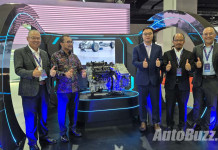
The new platform has also allowed for a new powertrain under the bonnet, which you’ll now find a new 1.5-litre Intelligent Green Technology (i-GT) four-cylinder engine, replacing the long-serving 1.3-litre four-cylinder. While details are scarce for now, the new i-GT mill is expected to be from the same engine family as the X50’s new four-cylinder, just without any forced induction here.
It’ll also be paired to a new CVT gearbox, in place of the four-speed automatic, which Proton says gives the Saga a fuel consumption rating of 4.9 L/100 km on the Malaysian Driving Cycle (MDC) – just 0.1 behind its chief rival, the Perodua Bezza 1.3.
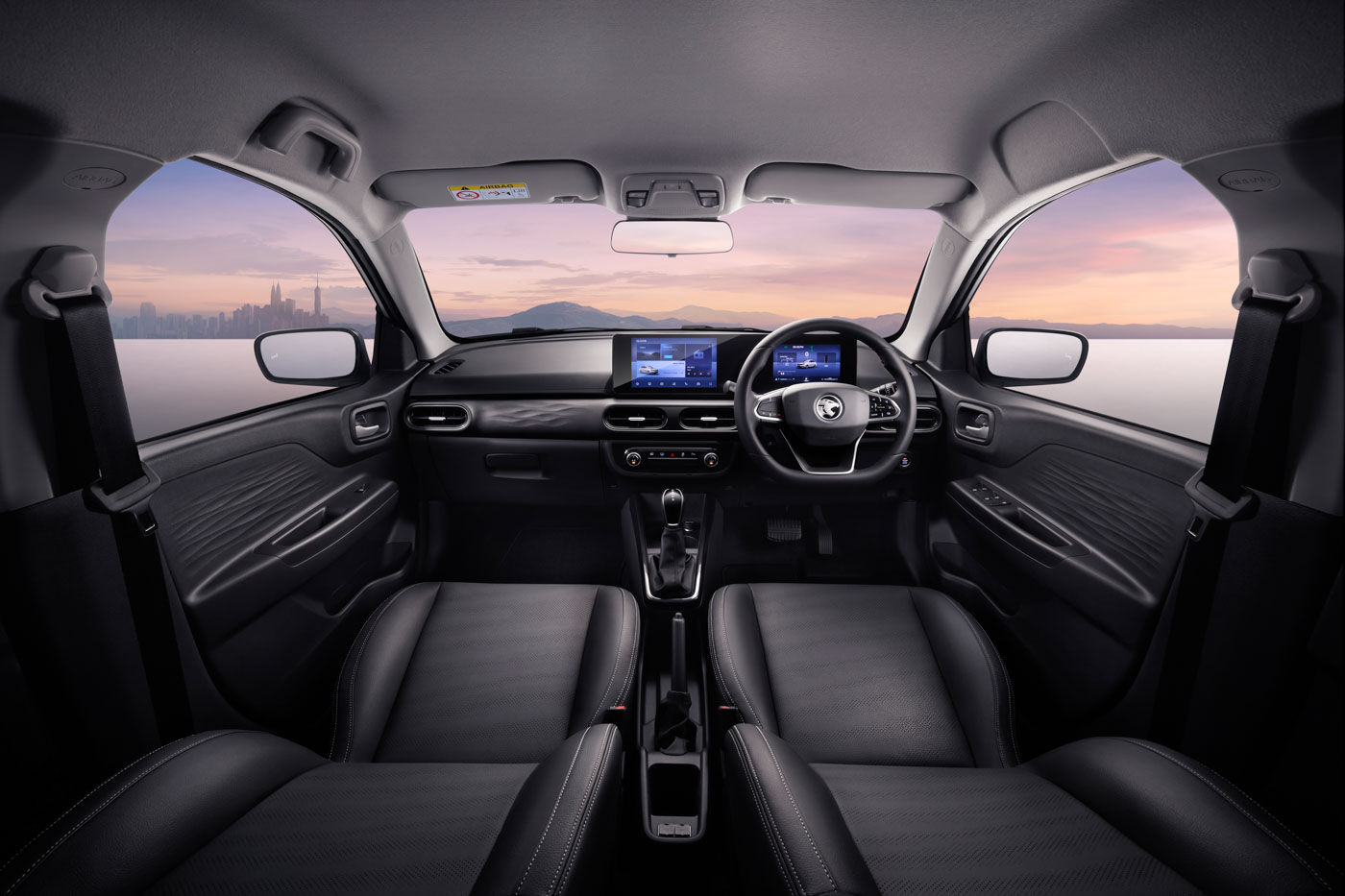
The interior of the all-new Proton Saga has also received a major revamp, centred around a new “16-inch dual-display”, serving as both the central infotainment display and the driver’s digital gauge cluster, the former supporting wireless Apple CarPlay and Android Auto from the factory.
The screens sit atop a significantly remodelled dashboard design, with a more modernised horizontal layout, where you’ll also find physical controls for the air-con alongside a new D-shaped steering wheel (now with electronic power steering). A moulded pattern on the dashboard and door cards add to the upmarket look, alongside the new oval-shaped air vents, as well as a new gear shift lever with gear indicators integrated directly on the knob.

With the new electrical architecture from the AMA platform, the all-new Proton Saga has also gained a suite of level one ADAS features, which include features such as autonomous emergency braking, lane departure warning, blind spot monitor with lane change assist, rear cross traffic alert, as well as rear collision warning.
Proton says these features work together with the six airbags and new Reinforced Safety Structure (RESS) with Hot Press Forming (HPF) components to offer “superior rigidity and protection”.
“The all-new Saga represents much more than the next chapter in our sedan legacy,” said Proton Edar deputy CEO Zhang Qiang, highlighting that it’s the national carmaker’s first model to be “fully designed, engineered, and validated by Malaysian talent” following its partnership with Geely in 2017.
It’s a huge step change for the iconic sedan that has helped kick-start our national automotive industry, and Proton would be hoping to bring the momentum forward in this new era of the company’s history. We can’t wait to see more – and we probably don’t have to wait too much longer!