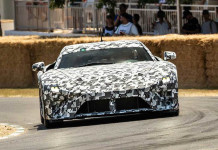
October 9th, 2025, will now be a day forever in Ferrari’s history books, as the iconic Italian supercar maker has now finally unveiled its first-ever all-electric model, marking the first Prancing Horse in history to be produced without a combustion engine… well, sort of.
Today’s announcement is just the first part of a staggered release. For now, we were only allowed to see the chassis and the powertrain of the future EV. The model is known (for now) as the Ferrari Elettrica – which literally means “Electric” in Italian – though don’t be surprised if the name changes when the rest of the car is revealed in full sometime in spring 2026.

First things first, the main star of the show. Powering the emissions-free Prancing Horse are four electric motors that Ferrari has developed completely in-house, featuring technology derived from Formula 1. These motors are housed in what Ferrari calls “e-Axles,” with two motors in each, alongside an also-self-developed inverter.
Dubbed the “Ferrari Power Pack” (FPP), the inverters weigh just 9 kg each and houses six modules made from silicon carbide (SiC), gate driver boards, and an integrated cooling system.
The front e-Axle delivers 285 hp (210 kW) and can be decoupled at any speed for a completely rear-wheel drive setup and maximise efficiency in conditions where all-wheel drive is not required. Under full acceleration, the front e-Axle can deliver up to 3,500 Nm of torque to the front wheels alone.

At the rear, it gets a pair of more powerful motors that produce a combined output of 843 hp (620 kW), and a tyre-shredding 8,000 Nm of torque in “Performance Launch” mode to the ground.
In its most powerful configuration, the Ferrari Elettrica’s total output is over 1,000 hp. This allows it to complete the 0-100 km/h sprint in just 2.5 seconds, with a top speed of 310 km/h.
Juicing these motors is a 122 kWh battery pack, also developed in-house by Ferrari. Maranello is claiming a range of over 530 km, although it has not yet disclosed which test cycle was used to achieve this figure.

The entire pack is integrated directly into the Elettrica’s floorpan. This packaging lowers the centre of gravity by 80 mm compared to a similar petrol-powered Ferrari, and achieves what the company calls an “optimal” 47:53 weight distribution. As for charging, the Ferrari Elettrica is based on an 880V architecture and can support DC fast-charging at 350 kW.
While EVs are typically heavier than their petrol-powered counterparts, Ferrari has focused intensely on lightweighting every core component of the Elettrica. This includes the compact and powerful e-Axles, which have a power density of up to 4.8 kW/kg. The in-house developed battery pack is not only a structural part of the chassis but is also touted by Ferrari to have the highest energy density of any EV so far, at 195 Wh/kg.
RELATED: Ferrari reinvents the icon with the all-new Ferrari 849 Testarossa

These powertrain components are housed in a new chassis that, according to Ferrari, has an extremely short wheelbase and is inspired by its mid-rear-engined sports cars. The driving position is placed nearer to the front wheels, a design borrowed from Maranello’s GT models to maximise comfort and accessibility.
According to Ferrari, the chassis was built around the “largest one-piece hollow casting ever produced” by the brand, designed to reduce overall weight. Bolted to the back of the main chassis is also an “elasticised mechanical subframe”, a first for the brand, which it says design helps to improve comfort by reducing noise and vibration, while still maintaining the driving dynamics expected of a Prancing Horse.
This approach also provides a lightweight yet rigid structure that ensures performance and allows for easier maintenance, as the powertrain, suspension, and battery are housed in a single, accessible load-bearing structure.

In a clever piece of engineering, the inverters for the active suspension system are housed directly in the subframe, which uses its own mass to isolate vibrations instead of requiring additional components. For further refinement, the subframe uses “specific bushes” to filter out rolling noise and vibrations from the e-Axles, ensuring a comfortable experience for the occupants.
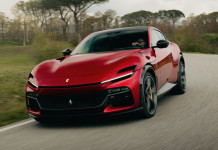
Aiding these dynamics is the third-generation 48V active suspension system, which first debuted on the Ferrari Purosangue. This advanced system distributes cornering forces to all four wheels, which should translate into a driving experience that is every bit as thrilling as its dinosaur juice-powered stablemates.
Even the tyres for the Ferrari Elettrica have been specifically engineered for the car. The project involved a collaboration with three different tyre manufacturers, who were tasked with creating a tyre that offered low rolling resistance without sacrificing handling performance in dry and wet conditions.
The result is a range of five dedicated tyres for the electric Ferrari: three designed for dry use, one winter tyre, and one with run-flat technology.

The Ferrari Elettrica offers three distinct drive modes: Range, Tour, and Performance. Each mode adjusts how the car manages its energy, available power, and traction. In addition, a set of steering wheel-mounted paddles allows the driver to cycle through five different levels of torque and power delivery.
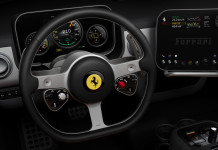
On the steering wheel is the familiar Manettino switch, which selects the settings for the vehicle’s dynamic systems. The modes range from an “Ice” setting that maintains all-wheel drive for low-grip conditions, all the way to an extreme “ESC Off” mode. In this setting, almost every traction control system is turned off, save for the active suspension and torque vectoring control.

A new “Dry” mode has also been added, which Ferrari says is suitable for day-to-day driving and slots in between the existing “Sport” and “Wet” modes.
The left side of the steering wheel, meanwhile, houses a new eManettino switch, offering three powertrain configurations for the Ferrari Elettrica, allowing the driver to switch between rear-wheel drive and all-wheel drive. All of this electronic wizardry is managed by a central Vehicle Control Unit, which updates 200 times per second to control the suspension, traction, and steering functions in real-time.

Furthermore, Ferrari states its Elettrica will “artificially replicate the timbre of an internal combustion engine.” While this essentially means a synthetic engine noise, Ferrari insists it is not a digitally generated sound.
Instead, the company calls it a “direct and authentic expression of its components.” This unique sound is reportedly achieved via a sensor installed on the rear axle that picks up the natural frequencies of the powertrain. These frequencies are then amplified and broadcast in a process similar to how an electric guitar creates its sound.
The Ferrari Elettrica will be the culmination of Ferrari’s long journey into electrification, a journey that started with the 599 HY-KERS prototype in 2010 that turned into the hybrid LaFerrari in 2013, and then the plug-in-hybrid SF90 Stradale that has also resulted in the 296 GTB to the 849 Testarossa.
We’ll learn more in the coming months leading up to the full reveal in spring 2026, and while this prancing horse might be a little quieter than its stablemates, there’s no doubt it will still be a true Ferrari. We can’t wait to see the full thing!
ALSO READ: The all-new Ferrari Amalfi is a more powerful Roma, with physical buttons inside
GALLERY