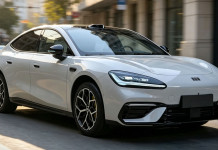
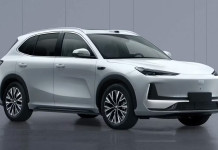
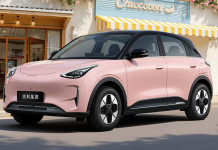
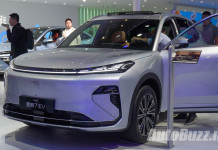
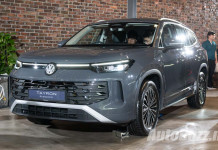
In a rather surprising turn of events, Geely has now also launched the fully electric (EV) Geely EX5 in Nepal. The Chinese cousin of the Proton eMAS 7 is available there in two variants, the Geely EX5 Pro and Geely EX5 Max, priced at NPR5.8 million (approx. RM175k) and NPR6.8 million (approx. RM205k) respectively.
This marks another potential conflict of interest between Geely and Proton, as the national brand also launched the eMAS 7 in Nepal earlier this year with a nearly identical price tag: NPR5.699 million (approx. RM172k) for the Prime variant and NPR 6.799 million (approx. RM205k) for the Premium variant.

Both the Proton eMAS 7 and Geely EX5 are currently built in China. However, whereas the EX5 is directly imported (CBU) from China, the eMAS 7 is currently imported to Nepal via Malaysia. This will continue until Proton’s first dedicated EV plant in Tanjong Malim goes online by the end of 2025.
This also means that both the Geely EX5 and Proton eMAS 7 share the same specifications. Both SUVs are powered by a front-mounted electric motor producing 218 hp (160 kW) and 320 Nm of torque, and are available with lithium-iron phosphate (LFP) battery packs in two capacities: 49.52 kWh and 60.22 kWh.
RELATED: Proton eMAS 7 makes overseas debut in Nepal – 2 variants imported from Malaysia

The launch of the Geely EX5 in Nepal raises questions about Proton’s overseas expansion plans, especially given Geely’s 49.9% stake in Proton. Geely has previously stated its intention to make Malaysia its regional right-hand drive (RHD) export hub, manufacturing both Proton and Geely models at the Automotive High-Tech Valley (AHTV) in Tanjung Malim.
However, that plan may now be in question. Geely has already launched the Geely EX5 in Thailand and Indonesia—two of ASEAN’s largest automotive markets. Even more directly, Geely has established a factory in Egypt to manufacture the Geely Emgrand and Coolray, models known to Malaysians as the Proton S70 and X50, despite Proton already having a plant in Egypt assembling the Proton Saga.

It remains to be seen how this apparent internal competition will play out. This strategy of selling nearly identical cars under different brand names in the same market is not unheard of; one only needs to look at the relationship between the Toyota Raize, Daihatsu Rocky, and the Subaru Rex in Japan, on which the Perodua Ativa is based.
The critical question for Proton is what this means for the company’s future. Will Geely’s strategy allow Proton to truly grow into a regional export hub, or will its ambitions be limited by the presence of its own Chinese cousins in key markets?
ALSO READ: Geely enters UK with EX5 – Proton eMAS 7 cousin to get Lotus ride and handling tuning